


Athletic polo is defined as a high-speed, team-based equestrian sport that demands elite physical conditioning, precise technical skill, and tactical intelligence from every player on the field. The role of athletic polo in sport extends far beyond its reputation as a pastime for the privileged. Two teams of four riders each use long-handled mallets to drive a wooden ball across a grass field, and the physical and cognitive demands placed on both rider and horse rival those of any recognized competitive sport. Understanding polo as a competitive sport means recognizing that it integrates horsemanship, biomechanics, and split-second decision-making into a single athletic discipline.
What athletic skills are essential for success in polo?
Polo demands a combination of physical attributes that few sports require simultaneously. Balance and core strength sit at the foundation. Riders must stay stable in the saddle at full gallop while rotating the upper body to swing a mallet, a movement that taxes the obliques, hip flexors, and stabilizing muscles with every stroke. Lose your seat for a fraction of a second and your shot accuracy collapses entirely.
Hand-eye coordination in polo operates at a level comparable to cricket or baseball, but with the added variable of a moving horse beneath you. Polo requires precise timing and balance to strike a ball accurately while simultaneously controlling horse speed and direction. That dual demand separates polo from almost every other ball sport, where the athlete’s feet stay planted.
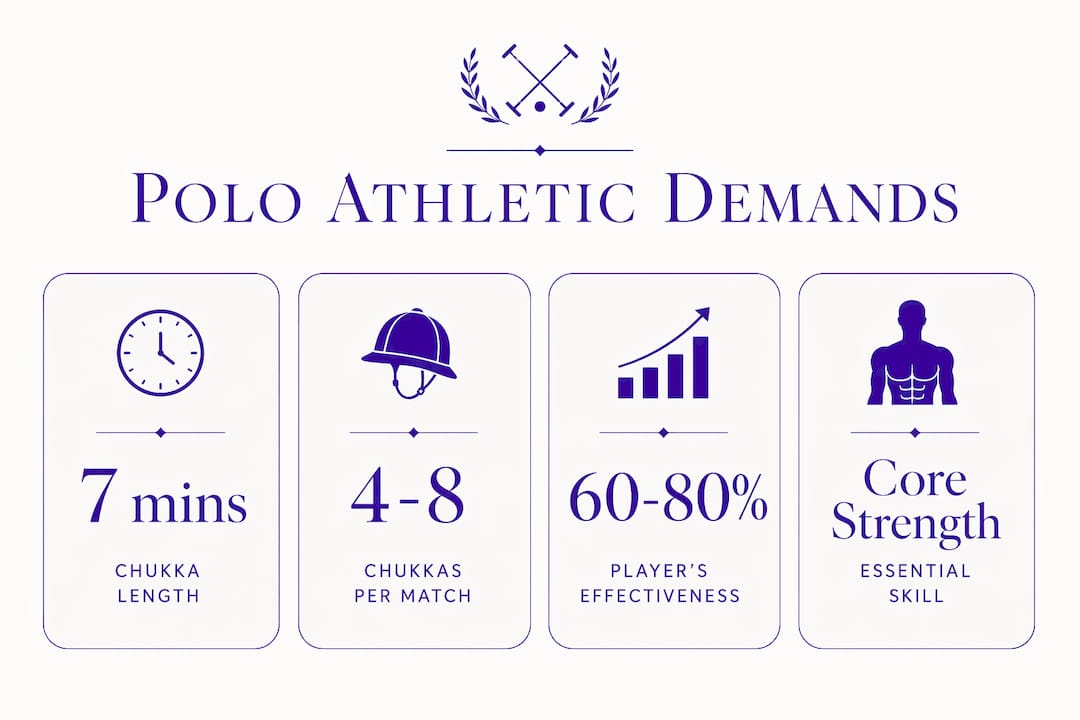
Endurance is the third pillar. A match spans multiple chukkas, each lasting seven minutes of continuous, high-intensity effort. Players who lack cardiovascular conditioning fade quickly, and fatigue directly degrades both riding quality and shot accuracy. Riders who train with interval conditioning, similar to the protocols used in rugby or soccer, maintain sharper decision-making late in matches.
- Balance and core stability: Riders must absorb the horse’s movement while generating rotational power for mallet swings.
- Hand-eye coordination: Accurate striking requires reading ball position, horse speed, and opponent positioning simultaneously.
- Cardiovascular endurance: Multiple chukkas demand sustained aerobic capacity and fast recovery between periods.
- Tactical intelligence: Reading the field, anticipating opponent moves, and communicating with teammates under pressure are non-negotiable.
- Horsemanship: Controlling horse direction and speed with minimal physical effort is a motor skill that takes years to develop.
Pro Tip: If you are new to polo training, prioritize core stability and hip mobility work before focusing on mallet technique. A strong, stable seat translates directly into more consistent and powerful shots.
The importance of athletic polo training lies in how it forces athletes to develop skills across multiple domains at once. Unlike a sprinter who trains one primary movement pattern, a polo player must condition the body, train the mind, and build a working partnership with an animal that has its own physical limits and behavioral tendencies.
How is polo’s physical format structured to demand athleticism?
The structure of a polo match is designed, whether intentionally or not, to create maximum physical stress on both rider and horse. Understanding that structure explains why polo conditioning programs look more like intermittent sport protocols than traditional equestrian training.
- Chukka length: Outdoor polo consists of four to eight chukkas, each lasting approximately seven minutes of active play.
- Rest intervals: Four-minute breaks between chukkas allow partial recovery, but the cumulative fatigue across a full match is significant.
- Mount changes: Players switch horses between chukkas to maintain peak performance, since a fatigued horse directly reduces a player’s effectiveness.
- Total match duration: A full outdoor polo match runs between 1.5 and 2 hours, placing sustained demands on rider conditioning.
- Continuous play within chukkas: Unlike basketball or American football, there are no timeouts during active play. Riders must make decisions and execute skills without pause.
The mount-changing protocol is one of polo’s most distinctive athletic features. Most pros attribute 60 to 80% of their performance to pony quality, which means managing a string of horses across a match is itself a strategic and athletic challenge. A player who mismanages their ponies’ workload will find their own performance declining in the final chukkas regardless of personal fitness.
| Sport | Active play period | Rest mechanism | Athlete controls |
|---|---|---|---|
| Polo | 7-minute chukkas | Mount changes, 4-min breaks | Rider and horse |
| Soccer | 45-minute halves | Halftime only | Rider only |
| Rugby | 40-minute halves | Halftime only | Athlete only |
| Basketball | 12-minute quarters | Timeouts, substitutions | Athlete only |
The comparison above makes polo’s intermittent demand structure clear. The sport shares the high-intensity burst pattern of rugby but adds the complexity of managing a second athlete, the horse, whose fatigue and welfare directly determine the rider’s competitive ceiling.
What unique challenges do polo players face in training and competition?
The challenges that separate polo from other competitive sports go well beyond physical conditioning. They involve managing a living partner, reading environmental conditions, and developing technical skills that most sports science programs have never formally studied.
Horse welfare is the most consequential variable in competitive polo. Ground conditions and horse age are the primary lameness risk factors identified in player surveys, with 58.6% of horse injuries linked to unfavorable footing. That statistic means every polo player must assess field conditions before competition, not just as a performance consideration but as a welfare obligation.
Facilities like Wellington International have responded by addressing footing, dust, and congestion directly, recognizing that better arena conditions produce safer environments and extend the competitive longevity of both horses and riders. The lesson for any serious polo athlete is that training environments matter as much as training volume.
- Pony scheduling: Each horse has a limited number of safe chukkas per week. Players must rotate their string carefully to avoid overuse injuries.
- Technical instruction gaps: Polo technique is often learned by imitation rather than formal biomechanical instruction, unlike tennis or golf. This limits how quickly players can correct inefficiencies.
- Environmental risk management: Hard, dry ground increases concussive forces on horse limbs. Wet, slippery ground raises the risk of falls. Players must adapt tactics to conditions.
- Integrated skill development: Riders must simultaneously improve riding mechanics, mallet technique, and tactical awareness. Progress in one area does not automatically transfer to the others.
- Team coordination: Polo is a four-player team sport. Individual brilliance without positional discipline and communication breaks down quickly against organized opposition.
Pro Tip: Record your riding sessions from a side angle whenever possible. Because polo technique develops largely through imitation, video review lets you identify mechanical inefficiencies that feel correct in the saddle but are clearly visible on screen.
The biomechanical logic behind polo techniques is an underexplored area that separates good players from elite ones. Understanding why a particular swing generates more power, or why a specific body position improves accuracy, accelerates development far beyond what observation alone can achieve.
How does polo influence broader sports culture and athlete development?
Polo’s impact on sports culture operates on several levels that most casual observers miss entirely. The sport has historically carried an exclusivity that obscured its genuine athletic demands, but that perception is shifting as polo grows more accessible and more diverse.
Female polo players have driven one of the sport’s most significant cultural shifts. Professional players like Melissa Ganzi and Lia Salvo have demonstrated that the physical and tactical demands of polo are not gender-specific, and women’s polo competitions now draw serious competitive fields at the international level. The sport’s structure, where rider skill and horse quality determine outcomes rather than raw physical size, creates a more level competitive environment than contact sports.
“Polo is the only sport where the athlete’s performance is inseparable from the welfare and conditioning of their partner. That relationship demands a kind of empathy and responsibility that no other competitive sport requires at the same intensity.”
The tactical intelligence developed through polo training transfers directly to other sports disciplines. Reading space, anticipating opponent movement, and making decisions at speed under physical stress are cognitive skills that coaches in rugby, basketball, and soccer actively try to develop. Polo players build these skills as a baseline requirement, not an advanced development goal.
The community dimension of polo also challenges the sport’s elitist image. Grassroots polo programs in Argentina, the United States, and the United Kingdom have expanded access significantly. The Argentine Polo Pony, recognized as the gold standard of polo horses worldwide, was developed through generations of selective breeding that reflects a deep national investment in the sport across all economic levels. Polo’s impact on sports culture in Argentina is comparable to soccer’s cultural weight in Brazil.
The benefits of athletic polo extend to mental conditioning as well. Managing a horse under competitive pressure requires emotional regulation, patience, and the ability to reset quickly after errors. These are psychological skills that translate directly to performance under pressure in any sport.
Key takeaways
Athletic polo is a multidisciplinary competitive sport that demands physical conditioning, tactical intelligence, and horse management skills in equal measure, making it one of the most complex athletic endeavors in competitive sport.
| Point | Details |
|---|---|
| Dual athlete demand | Rider and horse must both be conditioned; pony quality drives 60 to 80% of player effectiveness. |
| Intermittent intensity | Seven-minute chukkas with mount changes mirror the physical structure of rugby and basketball. |
| Technical instruction gap | Polo technique learned by imitation limits progress; biomechanical understanding accelerates improvement. |
| Horse welfare as performance | Ground conditions cause 58.6% of horse injuries, making field assessment a direct athletic responsibility. |
| Broader sports influence | Polo’s tactical and physical demands build transferable cognitive and physical skills relevant across sports. |
Why polo deserves more respect from the athletic community
I have spent years watching athletes from traditional sports dismiss polo as a rich person’s hobby, and every time I see that reaction, I know they have never watched a serious chukka up close. The physical reality of polo is jarring when you first encounter it. Riders are moving at 35 miles per hour, swinging a mallet with precision, reading a field of eight horses and riders, and communicating with a teammate, all at the same time. That is not a leisure activity. That is elite sport.
What strikes me most is the horse welfare dimension. Every other sport asks athletes to manage their own bodies. Polo asks riders to manage two. The responsibility of keeping a horse sound, fit, and confident across a competitive season is a form of athletic intelligence that most sports science programs have never formally addressed. Players who treat horse management as secondary to their own conditioning consistently underperform against those who treat it as the foundation.
The technical instruction problem is the one I find most frustrating. Polo has no equivalent of the ATP coaching certification or the PGA teaching framework. Most players learn by watching better players and copying what they see, which is an inefficient path to improvement. The players who break through that ceiling are the ones who start asking why a technique works, not just what it looks like. That shift from imitation to understanding is where real athletic development begins in this sport.
If you are a serious athlete looking for a discipline that will challenge every physical and mental capacity you have developed, polo deserves a serious look. It will not be easy. It will not be cheap. But it will demand more from you than almost anything else you have tried.
— Giuseppe
Gear that matches polo’s athletic standard
Polo demands performance from every element of your preparation, including what you wear. Moreciandco builds apparel around the principle of getting exactly what you pay for, which means fabric quality, fit, and durability that hold up to real athletic use.

The Complesso Collection from Moreciandco brings together luxury and athletic function in pieces designed for riders and sports enthusiasts who refuse to compromise on either. The Complesso Polo uses a bamboo-cotton blend that delivers breathability and softness through long training sessions and match days alike. When the sport demands this much from your body, your gear should be the last thing holding you back. Explore the full range at Moreciandco and wear something worth the effort.
FAQ
What is the role of athletic polo in sport?
Athletic polo functions as a competitive team sport that integrates horsemanship, physical conditioning, and tactical decision-making into a single discipline. It demands elite athleticism from both rider and horse, placing it among the most physically and cognitively complex sports in competition.
How many chukkas are in a polo match?
Outdoor polo consists of four to eight chukkas, each lasting approximately seven minutes, with four-minute breaks between periods. Players change horses between chukkas to maintain peak performance across the full match.
Why is horse welfare important in competitive polo?
Horse welfare directly determines player performance because ponies contribute 60 to 80% of a player’s effectiveness on the field. Ground conditions account for 58.6% of horse injuries, making field assessment and pony management core athletic responsibilities for every polo player.
How do polo players learn technique?
Most polo players develop technique primarily through imitation rather than formal biomechanical instruction, unlike golfers or tennis players who have access to structured coaching frameworks. Understanding the mechanical logic behind each stroke accelerates improvement beyond what observation alone can achieve.
Can polo training benefit athletes from other sports?
Polo training builds transferable skills including tactical field reading, decision-making under physical stress, and emotional regulation under pressure. These cognitive and physical capacities are directly applicable to team sports like rugby, basketball, and soccer.