


The most common t-shirt neckline types are crew, V-neck, scoop, boat, henley, mock/turtleneck, square, and polo, plus a handful of fashion cuts like off-shoulder, keyhole, and cowl. Crew and V-neck cover the widest range of body types and occasions, which is why they anchor almost every well-built wardrobe. Everything else is a variation you add once you know what you’re solving for.
TL;DR:
- Crew necks are the most versatile and durable T-shirt style, suitable for layering and offering the highest rewear and restock rates.
- Deep V-necks elongate the neck and balance broader upper bodies but require proper construction to prevent gaping or slipping after washing.
- Wide scoop and boat necks emphasize shoulder width, making them better choices for narrower frames or specific style statements.
- Neckline construction, including ribbed binding and reinforced seams, significantly impacts the longevity and fit of the shirt, often more than the shape itself.
- Higher-quality fabrics and stitching are essential for maintaining shape, especially at wider necklines like boat or deep V, to avoid early sagging or distortion.
Table of Contents
- Types of T-Shirt Necklines: What Each One Actually Does
- How to Choose the Right Neckline for Your Body, Wardrobe, and Purpose
- Neckline Choices and What They Mean for Design and Fit
- What Giuseppe and Moreciandco Have Learned About Necklines
- Keyhole Neckline
- Cowl Neck
- Sweetheart Neckline
- Why Neckline Choice Is a Longevity Decision, Not a Style One
- Where to See These Necklines Done Right
- Sources
Types of T-Shirt Necklines: What Each One Actually Does
Every neckline sends a different visual signal before anyone reads what’s printed on the shirt. Some widen the shoulders, some lengthen the neck, some quietly disappear under a jacket. Knowing the difference turns shopping from guesswork into a short checklist.
Crew Neck
The crew neck sits close to the base of the throat in a round, ribbed band that doesn’t dip below the collarbone. It’s the default t-shirt neckline for a reason: it’s the most common and versatile cut out there, and it leaves the largest uninterrupted stretch of chest fabric of any style, which is exactly why most printed t-shirt necklines default to crew first. That flat, open canvas is also why crew necks dominate merch racks and team uniforms.
On the body, a crew neck reads neutral. It doesn’t lengthen a short neck the way a V does, but it doesn’t shorten one either. It flatters almost every face shape and shoulder width because it doesn’t pull the eye in any particular direction. If you own exactly one t-shirt neckline, this is probably it.
V-Neck (Shallow vs. Deep)
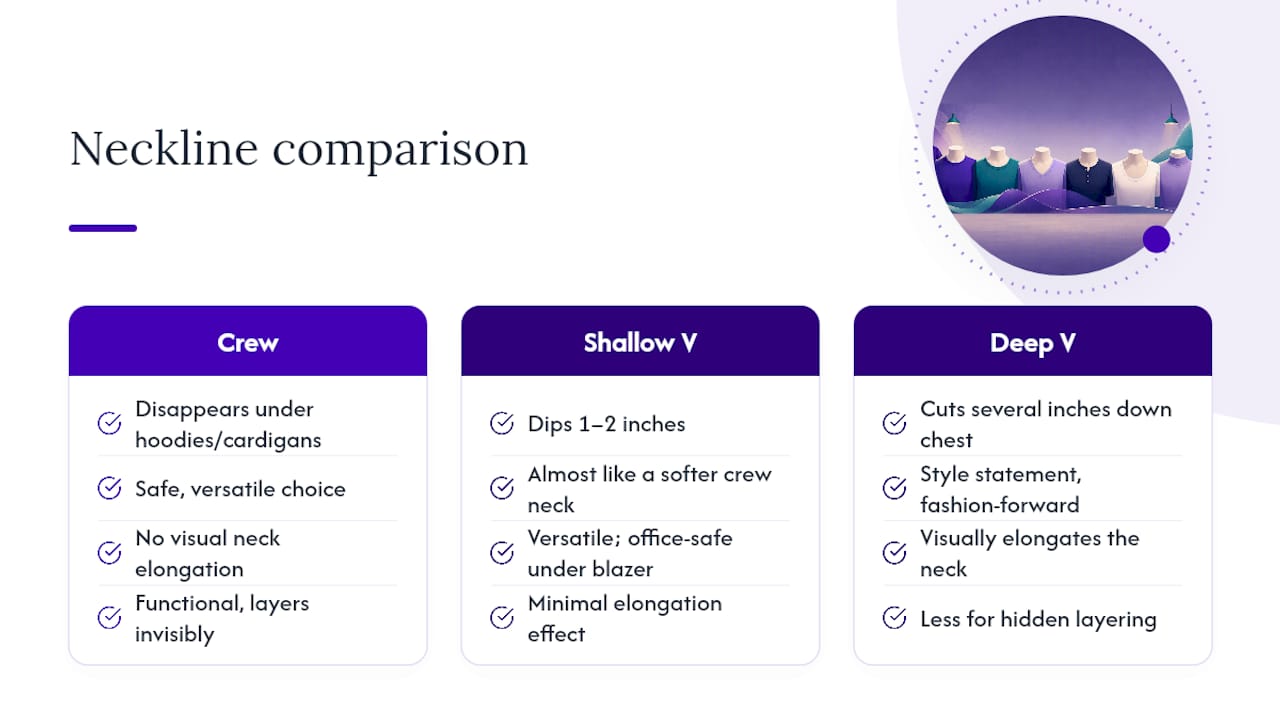
A V-neck cuts a triangle from the collarbone down toward the sternum, and depth changes everything about how it wears. Shallow Vs, dipping just an inch or two, behave almost like a softer crew neck: versatile, safe for the office under a blazer, fine for layering. Deep Vs, cutting several inches down the chest, are a style statement, and menswear editors are consistent on this point: V-necks visually elongate the neck and help balance a broader upper body, but the deeper you go, the more the shirt reads as fashion rather than function.
This is the heart of the v neck vs crew neck debate, and honestly it’s less “which is better” and more “which job are you hiring it for.” A V-neck is the better call if you have a shorter or thicker neck, since the diagonal lines break up that column and create the illusion of length. A crew neck is the safer call if you want a shirt that disappears under a hoodie or a cardigan without peeking out. For men specifically weighing v neck or crew neck, the honest answer is: own both, and let the neck length and layering plan decide which one goes on that morning.
Scoop Neck (U-Neck)
The scoop neck is a wider, deeper U shape that sits lower than a crew but without the sharp point of a V. It opens up more chest and collarbone than a crew, which makes it a warm-weather favorite and a common choice for fitted, athletic-cut tees. A deep scoop shares the V-neck’s lengthening effect on the neck, but the rounded bottom softens the look, so it tends to feel more casual and less “styled” than a deep V.
Scoop necks work well on narrower frames since the wide opening can visually broaden a shoulder line that’s already wide. If your shoulders are broad, a shallower scoop or a straight crew keeps things in proportion better than a wide one.
Boat Neck (Bateau)
A boat neck runs nearly straight across the collarbone from shoulder point to shoulder point, sitting high with almost no drop. That horizontal line is the whole story here. Necklines that build a straight line across the shoulders, including boat and wide scoop cuts, tend to emphasize shoulder width rather than minimize it. If you already have broad shoulders and want to look leaner up top, this is one to use sparingly. If you’re narrower through the shoulders, a boat neck adds welcome visual width.
Square Neck
The square neck trades curves for straight lines, cutting a rectangular opening across the collarbone and dropping straight down on each side before turning at the shoulder seams. It’s rare on standard t-shirts and more common on fitted tanks or structured knitwear, but it shows up occasionally on premium tee drops as a point of difference. It reads sharp and a little formal for a tee, and it pairs best with fitted long sleeves or a sleeveless cut. Pairing a square neck with bulky cap or puff sleeves can add unwanted shoulder bulk, so keep the sleeve simple if you want that structured look.
Henley (Button Placket)
A henley starts as a crew or slightly lower round neckline, then adds a short button placket, usually two to five buttons, running down the center of the chest. It sits between a t-shirt and a dress shirt in formality: buttonable enough to feel a step up, casual enough to wear untucked with jeans. The placket also breaks up the chest visually, which is worth remembering if you’re printing on one. It layers well under an open flannel or jacket, and leaving the top button or two open gives a slightly more relaxed, va-cation-ready look than a fully buttoned placket.
Mock Neck and Turtleneck Tees
A mock neck is a short standing collar, usually under two inches, that sits close to the throat without folding over. A turtleneck tee takes that same standing collar and doubles or triples it in height so it folds down. Both add warmth and a cleaner, more tailored silhouette than a crew, and both are excellent under blazers or jackets since they eliminate the “gap” a crew or V leaves at the collar. Neither is a great choice on a short neck. That height draws attention straight to a shorter throat and can make the whole look feel boxy.
Polo (Collared Tee)
The polo isn’t really a t-shirt neckline at all. It’s a different garment category, built around a folded collar and a short button placket. Polos are structurally distinct from crew or V-neck tees and function as a smart-casual alternative rather than a direct substitute. That collar structure does the work a blazer usually does: it reads more “put together” on sight, which is why polos land comfortably between a plain tee and a button-down on the formality scale. Moreciandco’s own collar style guide breaks down how different collar builds change that effect further.
Off-Shoulder, One-Shoulder, and Asymmetric Cuts
These are the outliers of the neckline world, cutting across or below one or both shoulders instead of following the natural neckline. They show up far more on women’s and fashion-forward apparel than on standard men’s tees, and they trade versatility for statement value. An off-shoulder cut widens the visual shoulder line dramatically, similar to a boat neck but more pronounced, so it’s a deliberate choice rather than a wardrobe staple. Layering is limited. There’s not much collar or shoulder fabric left to work with under a jacket.
Split Neck (Notch)
A small vertical slit at the center of a crew or scoop, usually an inch or two, is a split or notch neckline. It’s a subtle detail more than a structural change, softening the formality of a crew neck slightly without the commitment of a full henley placket. It’s common on premium basics that want a small design signature without adding buttons or bulk.
How to Choose the Right Neckline for Your Body, Wardrobe, and Purpose
Picking a neckline isn’t about trends. It’s about matching the shape of the cut to the shape of your body and the job the shirt needs to do. Here’s the process.
- Measure your neck length and note your shoulder width. A shorter neck benefits from a diagonal or curved line (V, scoop) that adds visual length. Broader shoulders benefit from the same diagonal lines, since horizontal necklines like boat and wide scoop tend to widen the shoulder line further, while V and deep scoop necks help balance that width out.
- Decide what the shirt needs to layer with. A crew or mock neck disappears cleanly under a jacket or hoodie. A wide scoop, boat neck, or deep V shows at the collar and can look messy peeking out from under outerwear.
- Pick depth deliberately, not by accident. A shallow V or modest scoop is close to universally wearable. A deep V or wide boat is a style choice that limits how often you’ll actually reach for it.
- Check the fabric and finish before you buy. Ribbed binding at the neckline holds its shape through washes far better than a plain hemmed edge, which tends to stretch out and sag within a season.
- Match sleeve construction to the effect you want. Raglan sleeves, which run in a diagonal seam from the collar to the underarm instead of a straight shoulder seam, soften the shoulder edge. That pairing works well if your goal is to minimize shoulder width alongside a balancing neckline.
If you’re shopping for a t-shirt and want to avoid returns, ask four questions before you check out: How deep does the neckline actually sit relative to the collarbone? Is there a placket or collar that will interrupt a chest print? What’s the neckline binding made of, and will it hold shape? And does the sleeve style add or reduce visual width at the shoulder? A broader guide to fit differences between slim and regular cuts is worth reading alongside this, since neckline and body fit compound each other rather than acting independently. The same logic applies to overall cut. A body-type decision guide for slim versus classic fit pairs directly with neckline choice, since a boxier fit and a wide boat neck together can add more shoulder width than either does alone. Fitting principles built around strap and shape placement, like the ones in this guide to choosing lingerie for your body, follow the same underlying logic of using neckline geometry to balance proportions, even outside menswear.
Pro Tip: Before buying a shirt with a deep V or wide boat neck, try it on and raise your arms overhead. If the neckline gaps open or slides toward one shoulder, the shirt lacks proper stabilizing stitches at the shoulder seam. That’s the detail that separates a shirt that looks good on the hanger from one that still looks good after a wash cycle.
Neckline Choices and What They Mean for Design and Fit
Neckline shape doesn’t just affect how a shirt looks on a body. It changes what you can actually do with the shirt afterward.
- A crew neck leaves the most usable chest space for a print or logo, since the round, high cut avoids interrupting the surface with any collar or placket.
- Henley plackets and polo collars break up that same chest space, so central artwork gets cut off by buttons; left-chest embroidery or a lower hem placement works better on either style.
- Ribbed or taped binding at the neckline costs more to produce than a plain hemmed edge, but it resists stretching and sagging through repeated washing, which matters most on wider scoop and boat necks that already carry more stress at the seam.
- Raglan sleeves change how a neckline reads on the body, since the diagonal seam softens the shoulder line, while set-in sleeves with a defined shoulder seam make a boat or wide crew neck look boxier by comparison.
For anyone ordering shirts for a team, event, or small brand, this is where neckline choice turns into a business decision. Crew and V-neck cuts consistently produce the highest reorder rates and lowest return risk for exactly the reasons above: broad fit tolerance, minimal print interference, and finishes that hold up over repeated wear.
What Giuseppe and Moreciandco Have Learned About Necklines
I’ve written before about why athletic V-neck shirts earn their place in a workout rotation, and about the mechanics behind different men’s collar styles, because neckline geometry is one of those details that quietly decides whether a shirt gets worn weekly or shoved to the back of a drawer.
Moreciandco builds around that idea directly. The Complesso Bamboo Cotton Tee uses a clean, close crew cut specifically because it’s the most forgiving neckline across body types and layering situations. The Complesso Polo takes the opposite approach on purpose, adding a structured collar for anyone who wants a step up from a plain tee without going full button-down.
Keyhole Neckline
A keyhole neckline is a crew or round neck with a small teardrop or diamond-shaped cutout just below the collarbone, usually an inch or two across. The name comes from the shape itself: a rounded top narrowing to a point, like the keyhole on an old lock.
On men’s tees, keyhole cuts are rare and mostly show up as a design detail on fashion-forward basics rather than everyday wear. The cutout adds a small amount of visual interest to an otherwise plain crew or scoop without changing the overall neckline depth or fit. It doesn’t meaningfully affect layering since the opening is small enough to stay hidden under a jacket or overshirt, and it doesn’t interfere with a standard chest print unless the artwork is centered directly over the cutout, in which case you’ll want to shift the design up or down to avoid the gap.
If you’re drawn to a keyhole cut, treat it the way you’d treat a split neck: a subtle detail, not a structural style choice. It works best on solid colors or minimal prints where the small cutout can actually be seen, rather than on busy graphics where it disappears into the design.
Cowl Neck
A cowl neck uses extra fabric at the neckline that drapes loosely rather than sitting flat against the body, creating soft folds that fall below the collarbone. It’s built with a bias cut or extra panel of fabric specifically so the material has enough give to hang rather than stretch tight.
Cowl necks are far more common on women’s tops and knitwear than on men’s t-shirts, where the draped fabric reads as a specific fashion choice rather than a basic wardrobe piece. On a t-shirt weight fabric, a cowl needs a certain amount of drape and weight to fold correctly. Very lightweight cotton tends to look limp rather than sculpted, which is part of why cowl necklines show up more often on heavier knits or blended fabrics with better structure.
For layering, a cowl neck is one of the least flexible cuts. The draped fabric bulks up under a jacket or sweater, and stacking it under another top usually flattens the fold that makes the style work in the first place. It’s a standalone piece more than a base layer.
Sweetheart Neckline
A sweetheart neckline curves into two rounded peaks that dip in the center, echoing the top of a heart shape. It’s a fitted, structured cut, traditionally associated with dresses and formal wear rather than casual t-shirts.
You’ll almost never see a true sweetheart neckline on a standard men’s t-shirt, since the curved double peak requires boning or structured seaming to hold its shape, which isn’t practical in a cotton jersey knit. Where it does appear, mostly on women’s fitted tops or occasion wear, it functions similarly to a scoop or V in terms of lengthening the neck and drawing the eye toward the collarbone, but with a more deliberate, tailored finish. For general t-shirt shopping, this one is worth knowing by name mostly so you can recognize it and rule it out when you’re after something casual and low-maintenance.
Why Neckline Choice Is a Longevity Decision, Not a Style One
Most people treat neckline as a purely aesthetic call, and that’s a mistake. A crew or shallow V, built with proper ribbed binding and reinforced shoulder seams, is the foundation every rotation should start from, because those two cuts flex across the most situations without asking you to think twice on a Tuesday morning.
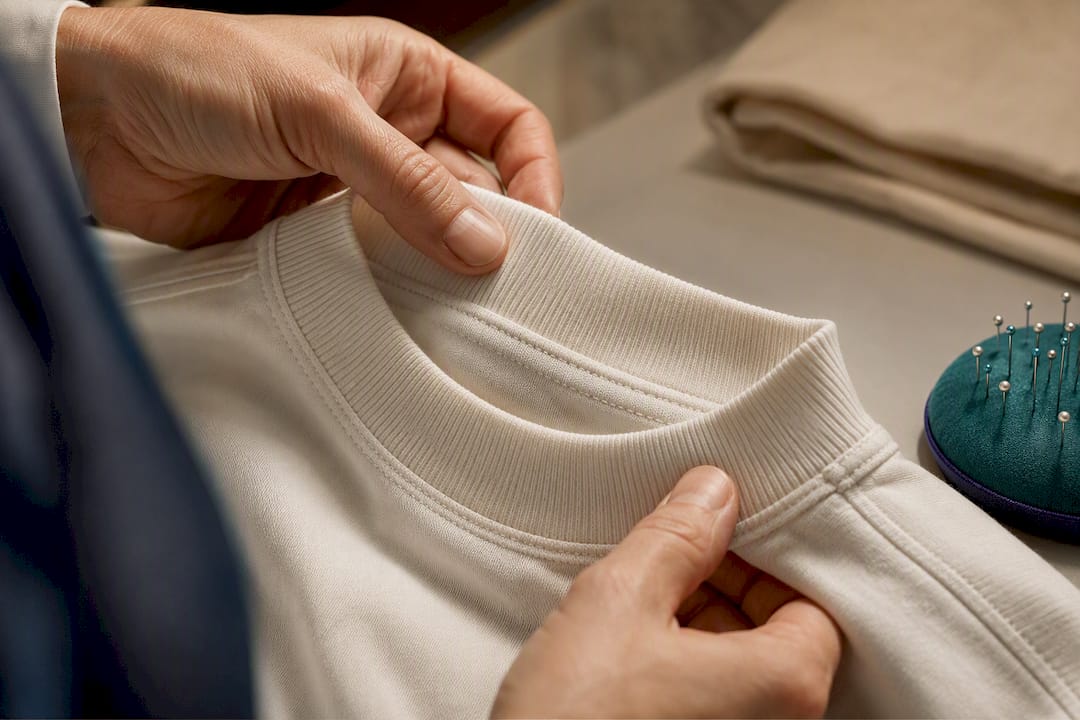
What I watch for isn’t the neckline shape at all. It’s what’s holding it together: taped seams at the shoulder, a ribbed band with real recovery instead of a flat hem that stretches out by month three, stitching dense enough that the collar doesn’t ripple after a wash cycle. A boat neck or deep V can look sharp in a fitting room and go loose and tired within weeks if the binding underneath is cheap.
Buy fewer necklines, and buy the construction behind them. A trendy cut with a weak collar is a shirt you’ll replace by winter. A well-built crew or V is one you’ll still be wearing next year.
— Giuseppe
Where to See These Necklines Done Right
Everything above is easier to picture than to shop for, so here’s where Moreciandco’s own lineup lines up with the cuts discussed. The Complesso Bamboo Cotton Tee runs a clean crew neck with a ribbed band built to hold its shape wash after wash, making it the shirt to reach for when you want the most versatile, layer-friendly option in your rotation.
The Complesso Polo is the pick when a plain crew feels too casual but a button-down feels like overkill. That structured collar does the smart-casual work a jacket usually handles, which makes it the better call for dinner, travel, or anywhere business-casual sits on the dress code. Between the two, you’re covering the two ends of the formality range with construction designed for durability. Browse the full Moreci Store to compare cuts side by side, or check the accessories collection if you’re rounding out the same outfit with a hat that matches the same no-nonsense approach to quality.
Sources
- T-shirt necklines
- V-neck vs crew-neck
- Which necklines balance a broad shoulders?
- 14 common types of T-shirt necklines: pros, cons, and a brand owner’s guide
- Crew Neck vs V-Neck vs Polo: Which Neckline Should Men Wear?