


A professional work wardrobe that actually functions comes down to five steps: Audit → Cull → Define palette and silhouette → Build core pieces → Set a maintenance routine. Do those in order and you can have a functional capsule ready in a single weekend. Here is how to start right now.
Your 5-step checklist:
- Audit: Pull everything out. Try on anything you haven’t worn in 90 days. If it doesn’t fit or you feel uncomfortable, it leaves.
- Cull: Sort into three piles: Keep, Repair/Tailor, Donate or Resell. Aim to keep only what you’d wear this week without hesitation.
- Define palette and silhouette: Pick two or three neutrals (navy, charcoal, stone) and one accent color. Stick to one or two silhouettes that flatter you.
- Build core pieces: Fill gaps using the 5-point style formula: Top + Topper + Bottom + Shoes + Accessories. A Moreciandco Complesso Tee or Complesso Polo works as a reliable neutral top in this formula.
- Set a maintenance routine: Weekly steaming, monthly shoe care, quarterly closet review.
Do this next: Bag the donate pile today. Tag one item for tailoring. Write down the single piece your wardrobe is missing most.
Key Takeaways
A professional capsule wardrobe built on fit, neutral foundations, and consistent maintenance outperforms a large, disorganized closet at every dress-code level.
| Point | Details |
|---|---|
| Five-step method | Audit, cull, define palette, build core pieces, set a maintenance routine — in that order. |
| Capsule size by role | 12–18 pieces for remote/casual roles; 18–25 for hybrid; 25–40 for frequent client-facing work. |
| Fit over price | A tailored $120 blazer reads more professional than an ill-fitting $400 one; tailor shoulders first. |
| Maintenance cadence | Steam blazers every 2–3 wears, polish shoes weekly, run a quarterly condition check. |
| Moreciandco Complesso pieces | The Complesso Tee and Complesso Polo serve as neutral base layers across business casual and smart casual dress codes. |
Table of Contents
- How to audit, declutter, and build a work capsule that fits your schedule
- What core pieces belong in each dress-code level?
- Outfit formulas and 15+ starter outfits you can wear next week
- How to arrange your closet and keep every piece ready to wear
- Where to invest, where to save, and how to tailor without overspending
- Why fit, maintenance, and dressing with intention actually matter
- The Complesso Collection fits your capsule where it counts most
- Sources
How to audit, declutter, and build a work capsule that fits your schedule
The fastest way to organize a professional work wardrobe is to start with what you already own, not what you plan to buy. A 60-minute audit beats a three-hour shopping trip every time.
The quick audit method
Pull every work item out of your closet and onto your bed. Ask two questions per piece: Would I wear this to work this week? and Does it fit right now, not after I lose five pounds? If the answer to either is no, it goes in the Repair or Donate pile. This “wear it this week” test cuts through the sentimental clutter faster than any other method.
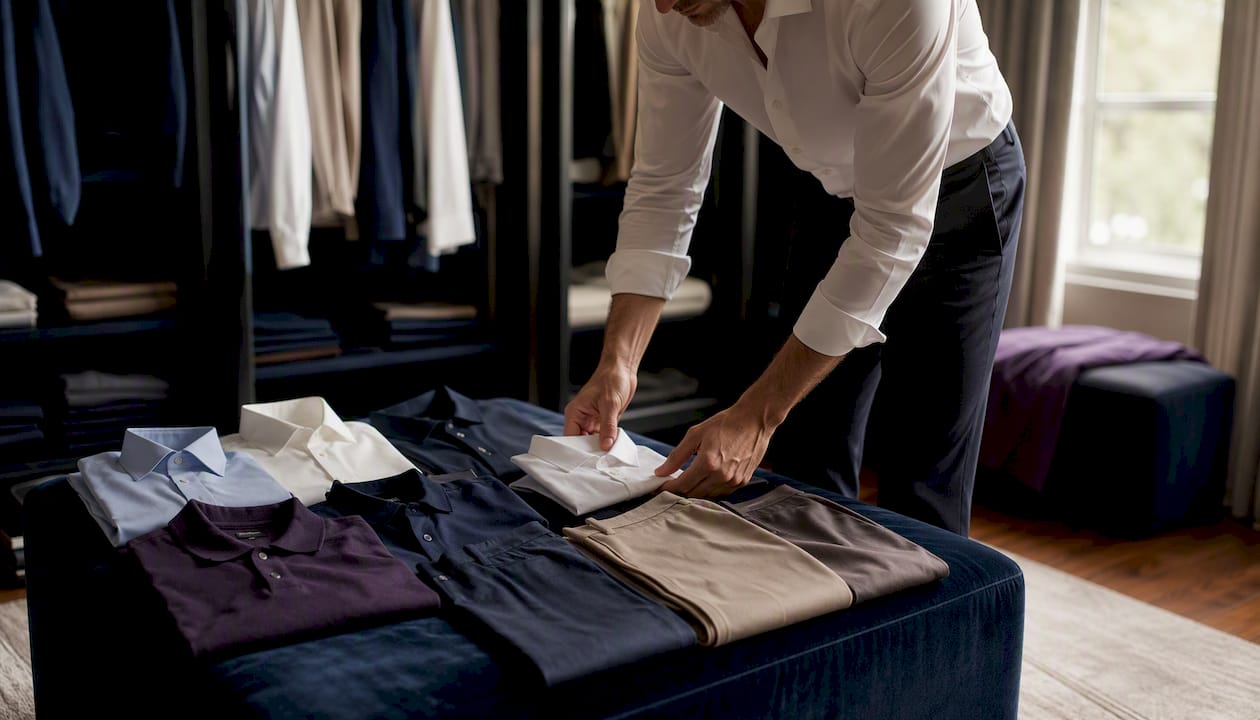
For anything borderline, use the 30-second hang test: hold it up, look at it for 30 seconds, and notice your gut reaction. Hesitation is a no.
Decision tree: keep, repair, donate, or replace
- Keep: Fits well, worn in the last 90 days, matches at least three other pieces.
- Repair/Tailor: Good fabric, good fit potential, but needs a hem, taper, or button.
- Donate or Resell: Doesn’t fit, outdated silhouette, or you’ve replaced it with something better.
- Replace: Worn out, pilling, or stained beyond recovery.
Declutter rules that actually work
Three frameworks are worth knowing. The 3-3-3 rule (three neutral foundations, three accent colors, three accessories) is best for travel or a quick rebuild when you need a minimal but functional set. The 18-piece capsule is a practical middle ground: an 18-piece work capsule can generate 40+ outfit combinations, making it a common sweet spot for hybrid professionals. Use the smaller frameworks when your dress code is consistent; scale up when you face varied client-facing demands.
The one-in/one-out rule keeps the capsule from creeping back to chaos: every new piece replaces one you already own.
Timeline: how long does this actually take?
| Scenario | Time needed | Approach |
|---|---|---|
| Closet reset (keep most pieces) | 1 hour | Audit + sort + identify one tailoring priority |
| Partial rebuild (fill 5–8 gaps) | Half day | Audit + sort + one focused shopping trip |
| Full capsule build from scratch | 3-month phased plan | Audit → buy neutrals first → add layers → add accents |
Capsule size by dress-code level
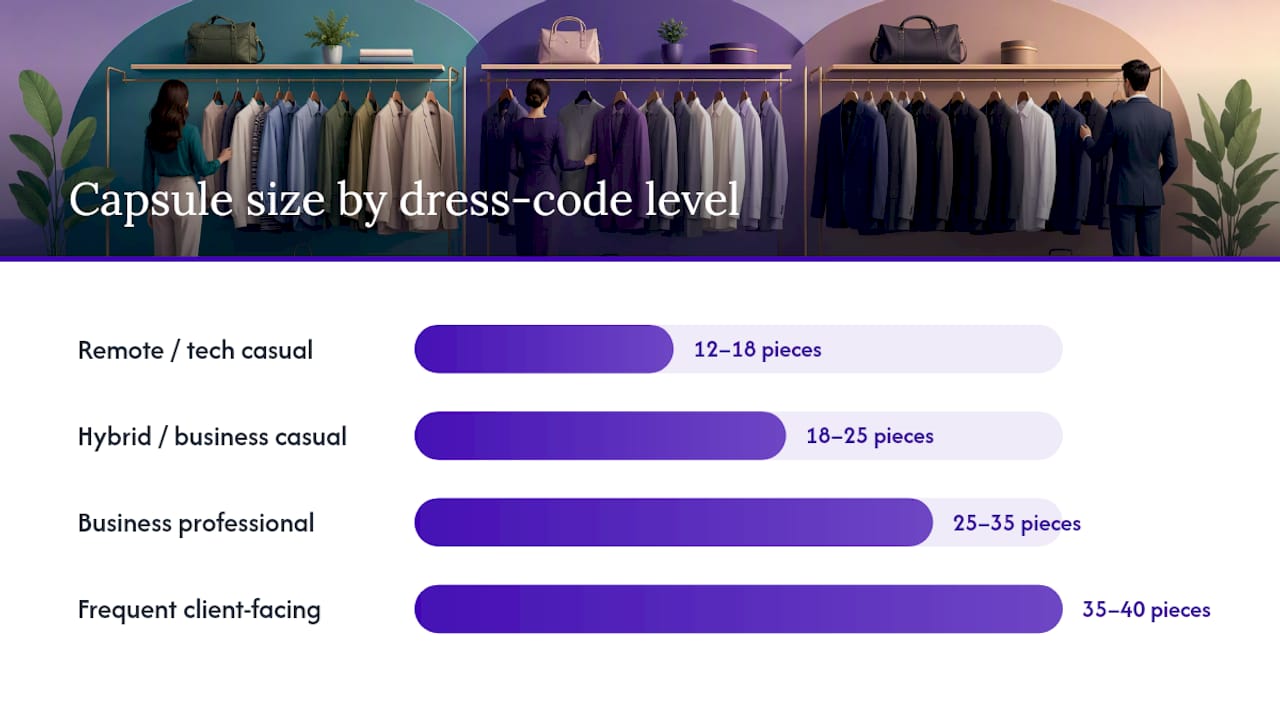
Career services guidance from Virginia Tech defines four distinct dress-code levels, each requiring a different capsule depth.
| Dress-code level | Recommended capsule size | Typical context |
|---|---|---|
| Remote / tech casual | 12–18 pieces | Home office, video calls, creative roles |
| Hybrid / business casual | 18–25 pieces | Mixed office and remote, open-plan offices |
| Business professional | 25–35 pieces | Client meetings, corporate offices |
| Frequent client-facing / formal | 35–40 pieces | Law, finance, consulting, executive roles |
Pro Tip: Tailor the blazer first. Shoulders and sleeve length are the two alterations that change how an entire outfit reads. A $40 tailoring job on a $90 blazer will outperform a $300 blazer that doesn’t fit.
What core pieces belong in each dress-code level?
The lists below follow standard business attire categories and give you exact counts to check against your current closet.
Business formal (35–40 pieces)
For courtrooms, executive boardrooms, and high-stakes client presentations.
- 3–4 tailored suits (charcoal, navy, mid-gray)
- 2 blazers (separate from suits)
- 6–8 dress shirts (white, light blue, pale pink, subtle stripe)
- 4–5 dress trousers
- 2 dress skirts or formal dresses (if applicable)
- 4–5 pairs of dress shoes (oxfords, cap-toes, classic pumps)
- 4–5 ties or silk scarves
- 2–3 leather belts
- 2–3 formal accessories (cufflinks, pocket squares, structured bag)
Business professional (a moderate number of pieces)
The standard for most corporate offices, finance, and consulting environments.
- 2–3 blazers (navy, charcoal, camel)
- 4–5 dress shirts or blouses
- 3–4 tailored trousers or dress pants
- 2 pencil or A-line skirts
- 2–3 structured dresses
- 3–4 pairs of shoes (loafers, low heels, clean leather sneakers for some offices)
- 2–3 sweaters or structured knits
- 2–3 belts and 2–3 accessories
Neutral palette suggestion: navy + charcoal + white as the base, with burgundy or forest green as one accent. The 70/30 principle applies here: keep most of your pieces in those neutrals and let one or two items carry the personality.
Business casual and smart casual (18–25 pieces)
The most common dress code in U.S. offices today. Business casual still requires intentional dressing: structured knits and clean flats can replace a blazer and heels while keeping the look polished.
- 2 blazers or structured jackets
- 4–5 tops (button-downs, structured tees, polos)
- 3–4 chinos or tailored trousers
- 1–2 dark-wash, un-distressed jeans (acceptable in many business casual settings)
- 2–3 pairs of shoes (loafers, clean leather sneakers, Chelsea boots)
- 2–3 sweaters or cardigans
- 2–3 accessories (watch, belt, minimal bag)
This is where Moreciandco’s Complesso Tee and Complesso Polo earn their place. Both are made from a bamboo-cotton blend, which means they hold their shape and color wash after wash. The Complesso Tee works as a neutral base layer under a blazer or structured jacket. The Complesso Polo reads as a complete top on its own for smart casual settings, video calls, or travel days when you need to look put-together without effort.
| Dress-code level | Core pieces count | Key neutrals | Accent strategy |
|---|---|---|---|
| Business formal | 35–40 | Charcoal, navy, white | Subtle (tie, pocket square) |
| Business professional | 25–35 | Navy, charcoal, camel | One color per outfit |
| Business casual | 18–25 | Stone, navy, white | One statement piece |
| Smart casual | 12–18 | Gray, olive, white | Texture over color |
Pro Tip: Start building with bottoms. Trousers and chinos are the hardest pieces to find in the right fit, and every top in your closet has to work with them. Get the bottoms right first, then fill in tops.
Outfit formulas and 15+ starter outfits you can wear next week
The 5-point style formula gives every outfit a structure: Top + Topper + Bottom + Shoes + Accessories. Fill each slot and you have a complete, intentional look. Leave one slot empty and the outfit usually reads as unfinished.
Repeatable outfit formulas
Formula A (Business professional): Dress shirt + blazer + tailored trousers + oxfords + leather belt and watch.
Formula B (Business casual, office): Structured tee or polo + chinos + loafers + minimal watch. The Complesso Polo slots directly into this formula as the top.
Formula C (Smart casual / hybrid): Clean crewneck or structured knit + dark chinos + Chelsea boots + minimal accessories.
Formula D (Video-call ready): Solid-color top (navy, white, or stone) + blazer or structured cardigan. Everything below the waist is irrelevant on camera, so invest the effort from the waist up.
15+ sample outfits across dress-code levels
Business formal:
- Charcoal suit + white dress shirt + burgundy tie + black cap-toe oxfords + leather belt
- Navy suit + pale blue shirt + no tie + dark brown oxfords + pocket square
- Mid-gray suit + white shirt + charcoal tie + black oxfords + silver cufflinks
Business professional: 4. Navy blazer + white button-down + charcoal trousers + brown loafers + watch 5. Camel blazer + light blue shirt + navy trousers + tan oxfords + leather belt 6. Charcoal blazer + white shirt + stone chinos + dark brown loafers + minimal tie 7. Navy blazer + structured tee (Complesso Tee in white or navy) + tailored trousers + loafers + watch
Business casual: 8. Complesso Polo (navy) + stone chinos + clean white leather sneakers + minimal watch 9. Structured knit + dark chinos + Chelsea boots + leather bag 10. Button-down (untucked, one button open) + slim chinos + loafers + no tie 11. Blazer + Complesso Tee (white) + dark jeans + clean leather sneakers + watch
Smart casual: 12. Complesso Polo (charcoal) + olive chinos + suede loafers + minimal accessories 13. Crewneck sweater + dark jeans + Chelsea boots + leather belt 14. Structured bomber jacket + button-down + slim chinos + clean sneakers 15. Cardigan + white tee + tailored trousers + loafers
Seasonal swaps
For summer, swap wool trousers for linen or cotton blends, replace heavy blazers with unstructured linen jackets, and move to lighter shoe colors. For winter, layering becomes the primary tool: a merino crewneck under a blazer, a wool overcoat over everything, and heavier leather shoes. The seasonal capsule plan from Moreciandco covers this rotation in detail.
Build a simple photo grid on your phone: one photo per outfit, organized by formula. On a rushed morning, you scroll, pick, and dress. Decision fatigue drops to near zero.
How to arrange your closet and keep every piece ready to wear
A capsule wardrobe only works if the closet supports it. Most professionals undermine their own system by storing everything together with no logic.
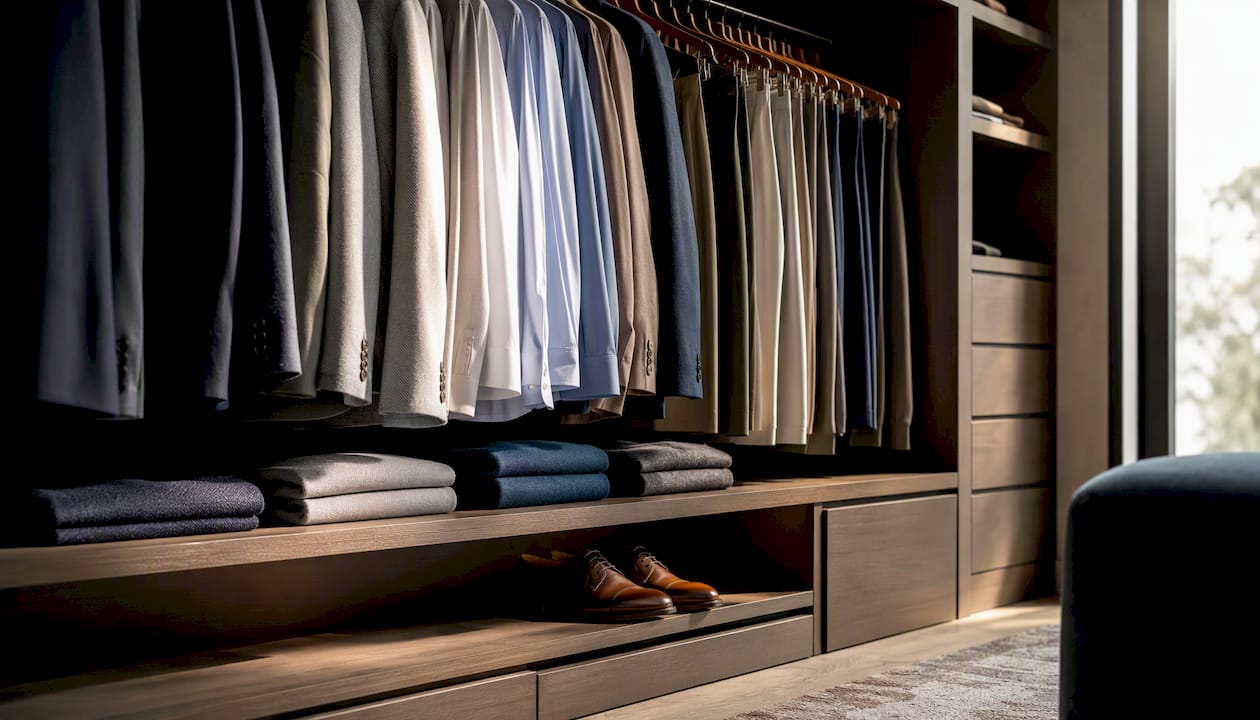
A simple closet layout
Divide your closet into four zones:
- Daily rotation zone: The pieces you wear most often, hung at eye level and easy to reach. This is where your capsule lives.
- Outfit photo zone: A small section (or a hook on the door) where you hang tomorrow’s outfit the night before.
- Repair/alteration bin: A small basket or bag for items that need a button, hem, or dry cleaning. Never let a broken piece back into the rotation zone.
- Donate/resale bin: Anything that failed the audit goes here immediately. Once it’s full, it leaves.
Maintenance checklist
Laundering by fabric:
- Cotton and cotton blends: machine wash cold, hang or tumble dry low.
- Wool and merino: hand wash or delicate cycle, lay flat to dry.
- Linen: machine wash gentle, iron while slightly damp.
- Bamboo-cotton blends (like Moreciandco’s Complesso pieces): machine wash cold, hang dry to preserve shape.
Steaming vs. ironing:
- Steam for wool, knits, and delicate fabrics. A handheld steamer takes two minutes and removes wrinkles without flattening texture.
- Iron for cotton dress shirts and linen. Ironing dress shirts properly means collar first, then cuffs, then body panels.
Shoe care:
- Polish leather shoes every 2–3 wears. Wipe with a damp cloth after each wear.
- Cedar shoe trees go in immediately after you take shoes off. They hold shape and absorb moisture.
- Suede: brush after every wear, use a suede protector spray monthly.
Garment bags: Use them for suits, blazers, and formal dresses. Hanging a blazer in a garment bag prevents shoulder dust and fabric compression.
Rotation and quarterly review
Rotate through your capsule pieces deliberately. Wearing the same two shirts every week while five others hang untouched defeats the purpose. A weekly plan (lay out five outfits every Sunday) keeps the full capsule circulating and shows you which pieces aren’t pulling their weight.
Every quarter, do a 20-minute condition check: look for pilling, fading, loose buttons, and worn soles. Anything that fails goes to the repair bin or the donate bin. This quarterly pass is also when you swap seasonal pieces in and out.
Storage for off-season pieces:
- Fold knits and store flat in breathable cotton bags. Never hang knits; the weight stretches the shoulders.
- Use cedar blocks or lavender sachets to deter moths.
- Hang structured pieces (blazers, trousers) in garment bags in a secondary closet or under-bed hanging storage.
Pro Tip: Polish your shoes on Sunday night, not Monday morning. A two-minute polish session at the end of the weekend means you never walk into a meeting with scuffed shoes.
Pro Tip: Steam your blazer after every second or third wear, not just when it looks wrinkled. Regular steaming kills odor-causing bacteria and keeps the fabric looking fresh far longer than dry cleaning alone.
Where to invest, where to save, and how to tailor without overspending
The single most effective thing you can do for professional perception is spend money on fit, not on labels. A well-fitted $120 blazer reads more polished than a $400 blazer that pulls at the shoulders.
Where to invest
- Blazers and structured jackets: These anchor every outfit. Buy the best you can afford and tailor them.
- Trousers and dress pants: Fit at the waist and thigh is hard to fake. Invest here.
- Shoes: Quality leather shoes last 5–10 years with proper care. Cheap shoes wear out in months and drag every outfit down.
- A quality watch: One clean, simple watch works across every dress-code level.
Where to save
- Basic tees and simple chinos: These are high-wear, lower-stakes items. A bamboo-cotton tee from Moreciandco gives you quality at a price that makes sense for a piece you’ll wear twice a week.
- Seasonal accent pieces: Trends shift. Don’t spend heavily on a trendy color or silhouette.
- Casual layers: Cardigans and unstructured jackets don’t need to be expensive.
Tailoring priority list
Tailoring is the highest-return investment in your wardrobe. Here is what to prioritize, in order:
- Blazer shoulders and sleeve length: Shoulder seams must sit at the edge of your shoulder. Sleeve length should show a quarter inch of shirt cuff. These two alterations cost roughly $30–$60 and transform the garment.
- Trouser hem and waist: A proper hem costs $15–$25. Taking in the waist runs $20–$40. Both are fast and make trousers look custom.
- Shirt tapering: A dress shirt that billows at the torso looks sloppy regardless of price. Tapering costs $20–$35 and makes any shirt look intentional.
The three-outfit test
Before buying any new piece, ask: Can I make at least three good outfits with this using what I already own? If the answer is no, put it back. This test alone prevents most impulse purchases that never integrate into the capsule.
Replacement timeline for high-wear items
- Dress shoes: Every 2–4 years with proper care and resoling.
- Dress shirts: Every 1–3 years depending on wash frequency and fabric quality.
- Trousers: Every 2–3 years for high-wear pairs.
- Blazers: Every 3–5 years, or when the lining or structure fails.
For business casual wardrobe essentials, the replacement cycle is slightly faster because casual pieces see more varied use.
Why fit, maintenance, and dressing with intention actually matter
The evidence for dressing well at work is less about fashion and more about perception. Career services guidance from Virginia Tech and business attire resources from Black Tie Attire both emphasize that dress-code alignment signals awareness of professional context, not just personal taste.
The practical implication: leaders who dress slightly more formally than the workplace norm tend to be perceived as more competent and promotable. Fit and maintenance drive that perception more than price. A wrinkle-free, well-fitted outfit in a mid-range fabric consistently outperforms an expensive but unkempt one.
Indeed’s career guidance makes this explicit: a well-fitted, lower-cost piece is usually preferable to an expensive, ill-fitting item. Fit and upkeep are stronger predictors of professional perception than brand price alone.
The 18-piece capsule model from CapsuleWardrobe.ai demonstrates the practical payoff: a small, curated set of mix-and-match pieces produces 40+ outfit combinations, which means you never run out of options and you never waste time deciding. The Minimize My Mess capsule checklist reinforces this with the 3-3-3 framework: three neutral foundations, three accent colors, and three accessories can generate 15–20 outfits from nine items.
The 5-point style formula (Top + Topper + Bottom + Shoes + Accessories) works because it forces completeness. Professionals who use a consistent formula report fewer “I have nothing to wear” mornings, not because they own more, but because every piece was chosen to work within a system.
Maintenance is the part most professionals underestimate. Wrinkle-free, stain-free garments frequently outperform expensive labels in perceived professionalism. A $60 shirt that is always pressed reads better than a $200 shirt worn rumpled.
The case for a curated capsule, from someone who thinks about this daily
Most wardrobe advice focuses on what to buy. The harder problem is what to keep, and more importantly, what to let go of. A closet full of “maybe someday” pieces is just deferred decision-making. It costs you time every morning and mental energy you could spend elsewhere.
The capsule approach works not because it limits you, but because it removes the wrong decisions from your day. When every piece in your closet fits, works with three other pieces, and is in good condition, getting dressed stops being a problem. It becomes a two-minute task.
Giuseppe’s seasonal capsule writing on the Moreciandco blog reflects this same philosophy: practical outcomes over aspirational collecting. The goal isn’t a beautiful closet. The goal is a wardrobe that works for your actual life, your actual schedule, and your actual dress code.
Moreciandco’s product philosophy aligns with this directly: quality materials, clean design, and pieces that hold up over time. That is what “getting what you pay for” means in practice.
The Complesso Collection fits your capsule where it counts most
The Complesso Tee and Complesso Polo from Moreciandco were built for exactly the roles that capsule wardrobes need filled: neutral base layers that hold their shape, travel without wrinkling badly, and work across multiple dress-code levels.
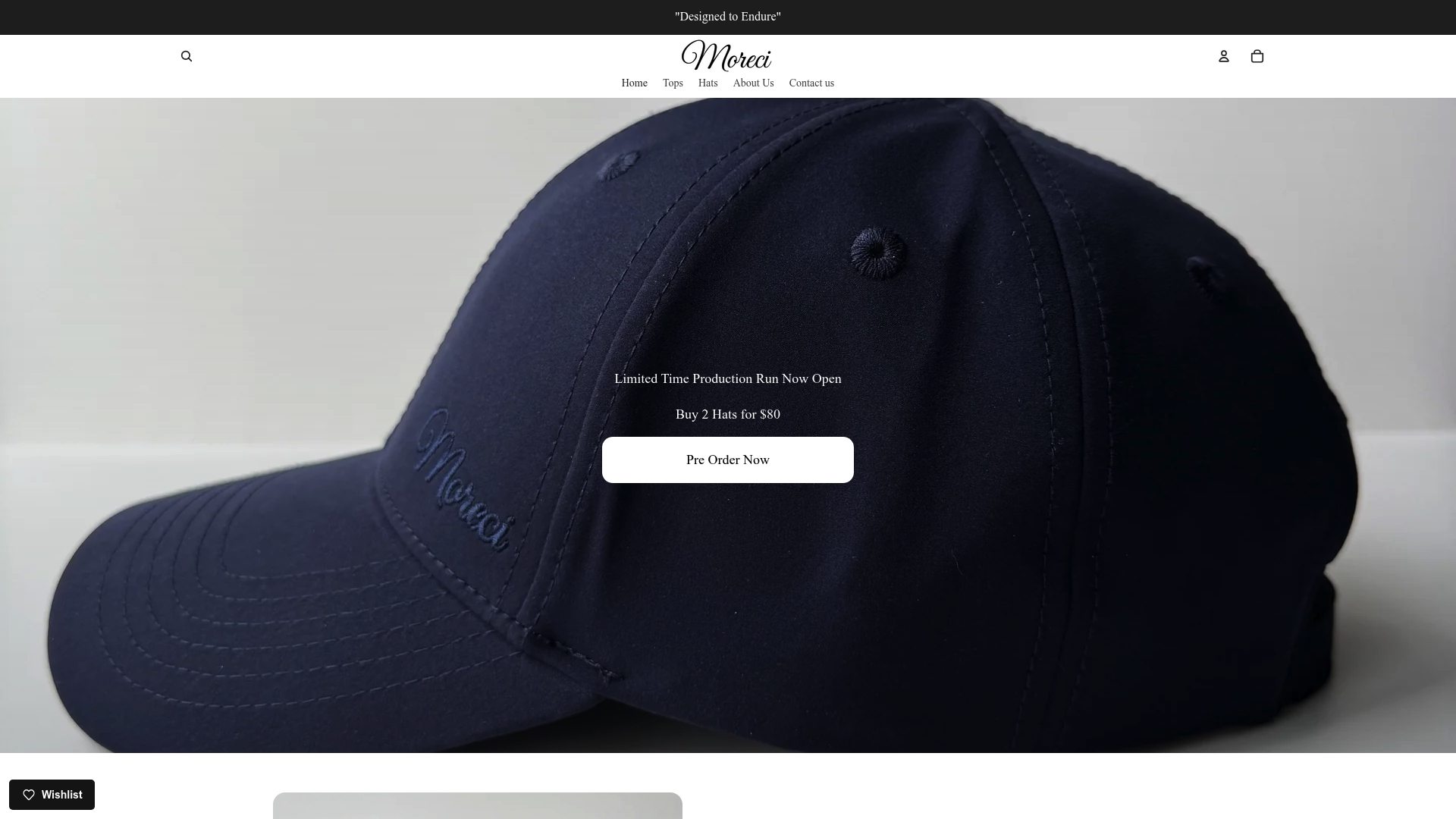
The Complesso Tee in white or navy sits under a blazer for business casual, works alone for video calls, and packs flat for travel. The bamboo-cotton blend means it breathes in summer and layers cleanly in winter. The Complesso Polo reads as a complete top for smart casual settings: structured enough for a client call, relaxed enough for a hybrid office day. Neither piece needs ironing after a proper hang-dry.
For professionals building or rebuilding a capsule, these are the pieces you buy first and replace last. Browse the full Complesso Collection to see how each piece slots into the formulas covered above, and pick the neutral base layer your capsule is currently missing.
Sources
- Professional dress codes | Virginia Tech Career and Professional Development
- Business attire — Black Tie Attire
- The Only Work Capsule Wardrobe Checklist you need (cheat sheet) - 2026 — Minimize My Mess
- Capsulewardrobe
- Guide to business attire — Indeed Career Advice