


Midsole cushioning is the foam layer sandwiched between your shoe’s insole and outsole, and it is the single structural element most responsible for how landing shock travels through your foot, ankle, knee, and hip. Its primary job is shock absorption — slowing the rate at which ground reaction forces reach your joints — but it also governs energy return, stability, and how your neuromuscular system adapts with every stride. Get it right and your joints benefit over long-distance runs. Get it wrong and you are fighting the shoe instead of the course.
Two trade-offs define almost every midsole decision:
- Cushioning vs. stability: Softer foam reduces loading rate but compresses under load, which can increase frontal-plane movement at the ankle and knee. Firmer foam keeps you more stable but transmits force faster.
- Cushioning vs. responsiveness: Plush foams absorb energy well but lose some of it as heat. Responsive foams (think PEBA-based compounds) return more energy to your stride but often sacrifice some shock attenuation.
World Athletics caps legal stack height at 40 mm for road race shoes used in record-eligible competition, which tells you how seriously governing bodies take the mechanical influence of midsole thickness. A 2025 controlled study published in MDPI confirmed that runners actively change ankle and knee stiffness when midsole hardness changes, meaning the shoe and the body are always negotiating. The sections below unpack every layer of that negotiation.
Table of Contents
- What exactly is midsole cushioning, and how does it differ from padding?
- How does midsole cushioning actually absorb impact forces?
- What materials and technologies make up a modern midsole?
- How do firmness and stack height shape your run’s trade-offs?
- How does cushioning affect performance and injury risk in practice?
- How to choose the right midsole cushioning for your goals
- Common myths about midsole cushioning that keep runners confused
- What recent research actually says about midsole cushioning
- Key Takeaways
- A perspective on what the research actually means for how you gear up
- Useful sources for deeper study
What exactly is midsole cushioning, and how does it differ from padding?
Midsole cushioning and padding are not the same thing, and confusing them leads to bad shoe choices. The midsole is a structural foam layer built into the shoe’s sole stack, sitting between the removable insole on top and the rubber outsole on the bottom. It is engineered, compressed, and bonded as part of the shoe’s architecture. Padding, by contrast, refers to soft material in the upper, collar, or tongue — comfort features that affect how the shoe feels on your foot but do nothing meaningful to manage ground reaction forces.
A few terms worth knowing before going deeper:
- Stack height: The total thickness of the sole measured from the ground to the top of the midsole, usually reported in millimeters at the heel and forefoot. Higher stack = more foam between you and the ground.
- Heel-to-toe drop: The difference in stack height between heel and forefoot (e.g., 10 mm heel stack minus 6 mm forefoot stack = 4 mm drop). Drop influences foot strike pattern and load distribution, independent of total cushioning volume.
- Durometer / Shore A: A hardness scale used to measure foam stiffness. Lower Shore A values mean softer foam; higher values mean firmer. Most running midsoles fall somewhere between Shore A 20 and 45.
- Energy return: The percentage of energy stored during compression that the foam releases back to the runner. Higher energy return feels “bouncy”; lower return feels “dead” or “mushy.”
- Bottom-out: The point at which foam compresses fully and can no longer deform further, effectively stopping all shock absorption. A bottomed-out midsole transmits force almost as directly as running on a hard surface.
Marketing terms like “max cushion,” “plush ride,” or “ultra-responsive” map loosely onto these technical properties but are not standardized. When a brand says “max cushion,” it usually means a stack height above roughly 35 mm combined with a softer durometer. “Responsive” typically signals higher energy return, often achieved through denser or chemically different foam. Neither term tells you the actual Shore A value or measured energy return percentage, so treat them as starting points, not specifications.
How does midsole cushioning actually absorb impact forces?
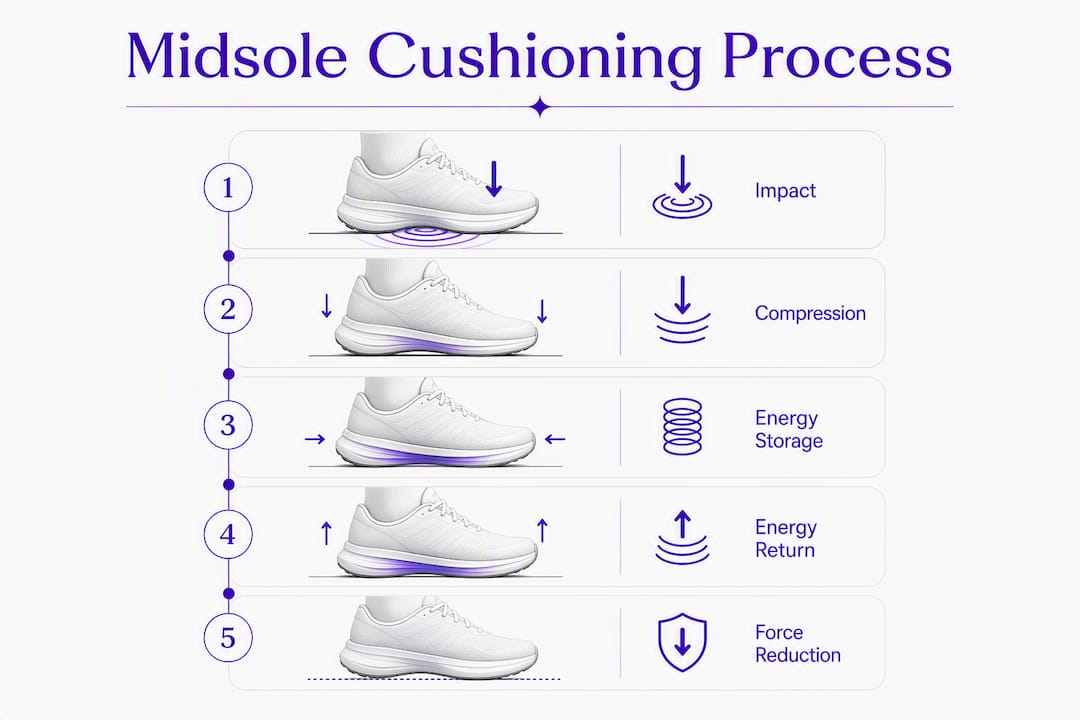
When your foot strikes the ground, the body generates a vertical ground reaction force that can reach two to three times body weight in a single step. The midsole’s job is to spread that force over a longer time window, reducing the loading rate — how quickly peak force is reached — even when the peak force itself remains high.
Think of it this way: a stiff surface delivers the same total force as a cushioned one, but it delivers it almost instantaneously. Foam slows the rise, giving your muscles and tendons more time to absorb and redirect energy. That time extension is what matters most for joint health over thousands of repetitions.
Energy storage and return work on a simple mechanical principle. As foam compresses, it stores elastic energy. When it rebounds, it releases some of that energy back into the stride. How much it releases depends on the foam’s resilience. Traditional EVA returns roughly 55–65% of stored energy. Advanced PEBA-based foams can return significantly more, which is why shoes built around those compounds feel noticeably springier. The energy that is not returned is lost as heat, which is why a mushy shoe feels like running in sand: you are doing extra work with every step.
The neuromuscular side of this is where it gets genuinely interesting. Research on recreational heel-toe runners found that softer midsoles increased the impact peak while reducing the loading rate, and runners responded by increasing ankle stiffness to compensate. That is the body self-regulating: when the shoe gets softer, the leg gets stiffer. The implication is that cushioning does not simply reduce all forces uniformly. It redistributes them, and the runner’s nervous system adjusts in real time.
A force-time curve for a cushioned shoe versus a minimal shoe illustrates this clearly: the cushioned shoe shows a shallower, broader curve (lower loading rate, extended time to peak), while the minimal shoe shows a sharper, narrower spike. The area under both curves is similar — total impulse is governed by body weight and velocity — but the shape of the curve is what determines joint stress over a long run.
What materials and technologies make up a modern midsole?
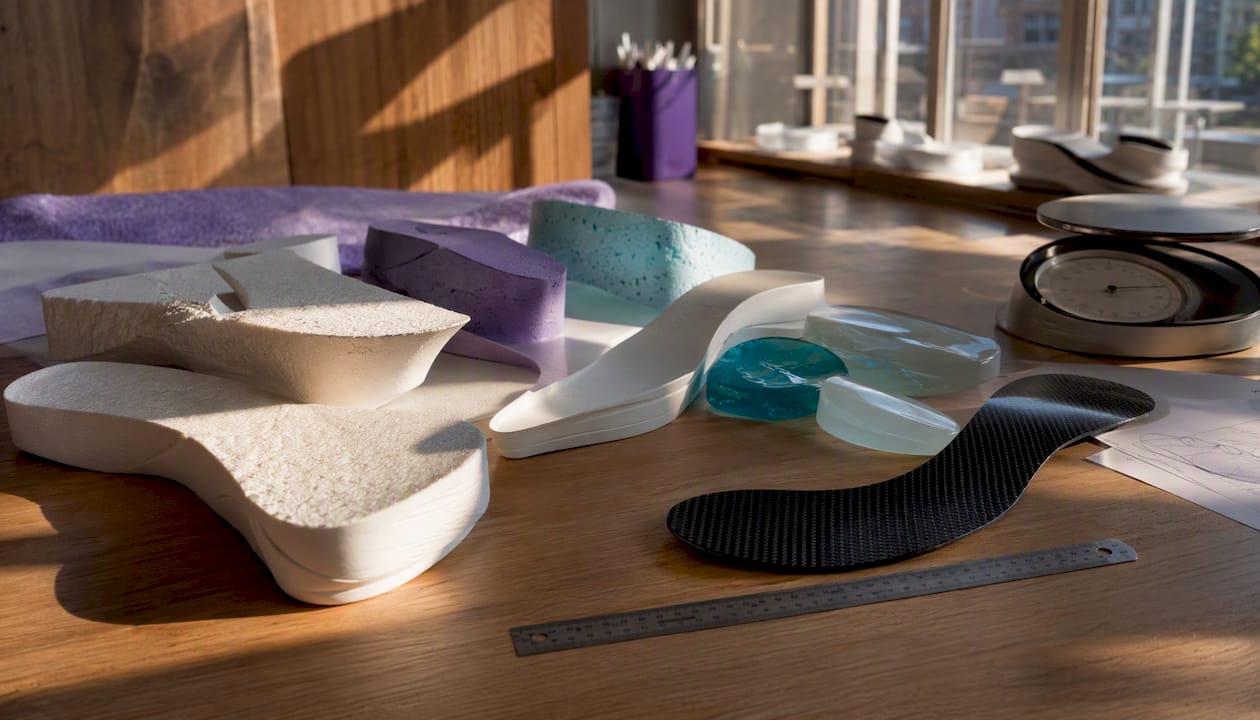
The foam in your midsole is not generic. Material choice drives almost every performance characteristic you feel on a run, from weight to warmth sensitivity to how long the shoe lasts.
EVA (ethylene-vinyl acetate)
EVA has been the industry standard for decades. It is lightweight, inexpensive to manufacture, and easy to tune by adjusting density. Softer EVA feels plush underfoot; denser EVA feels firmer and more stable. The downside is durability: EVA degrades with mileage and loses measurable cushioning over hundreds of kilometers, becoming effectively firmer as the foam cell structure breaks down. Cold temperatures accelerate this stiffening, which matters for winter runners.
Polyurethane (PU)
PU is denser and more durable than EVA, which is why it appears in work boots and shoes designed for all-day standing. For running, the trade-off is weight: PU midsoles are heavier, which penalizes running economy. Some stability trainers use PU in medial post constructions precisely because it resists compression better than EVA.
PEBA / PEBAX-based foams
Polyether block amide foams represent the current performance frontier. They offer higher resilience than EVA (more energy return), lower weight, and better performance in cold conditions compared to traditional EVA, which stiffens significantly below about 40°F. The trade-off is cost and, in some constructions, durability. These foams appear in high-end race shoes and premium daily trainers.
Gel inserts and air chambers
Gel pockets (silicone-based compounds) and pressurized air chambers are targeted cushioning technologies rather than full-midsole solutions. They concentrate impact absorption at the heel or forefoot where peak forces occur. Both add weight relative to foam-only designs, but they can extend effective cushioning life in high-wear zones.
Lattice and zoned constructions
Recent advances in midsole engineering have moved away from uniform foam blocks toward lattice geometries and zoned density constructions. A lattice structure — often 3D-printed — can vary stiffness across the footbed, placing softer zones under the heel and stiffer zones under the midfoot for stability, all within a single piece of material. This approach reduces mass while maintaining targeted protection.
Carbon fiber and TPU plates
Plates embedded in the midsole do not cushion directly. They stiffen the forefoot, alter the shoe’s lever mechanics, and work in combination with highly resilient foam to improve energy return and running economy. The plate amplifies the foam’s energy return rather than replacing it.
| Material / Technology | Typical feel | Energy return | Durability | Best use case |
|---|---|---|---|---|
| Standard EVA | Soft to medium | Moderate | Moderate | Daily trainers, budget shoes |
| High-density EVA | Firm | Moderate | Good | Stability shoes, medial posts |
| PU | Firm, dense | Low-moderate | High | Work/walking shoes, stability inserts |
| PEBA-based foam | Springy, light | High | Moderate | Race shoes, premium trainers |
| Gel / air inserts | Plush, targeted | Low | Good in targeted zones | High-impact heel/forefoot zones |
| Lattice / zoned foam | Variable | Variable | Good | Performance trainers, custom-feel designs |
| Carbon / TPU plate | Stiff, propulsive | High (with foam) | High | Race shoes, tempo trainers |
Pro Tip: Cold weather stiffens EVA noticeably. If you run in temperatures below 40°F regularly, a PEBA-based or PU midsole will maintain more consistent cushioning than a standard EVA shoe that feels plush in the store but firms up on a January morning.
How do firmness and stack height shape your run’s trade-offs?
Firmness and stack height are the two dials runners and shoe designers adjust most, and they pull in opposite directions on almost every performance metric.
Softer midsoles reduce loading rate, which is the rate at which peak ground reaction force builds. Lower loading rates are associated with reduced stress on bones and connective tissue over long distances. The cost: softer foam compresses more under load, which can increase mediolateral (side-to-side) movement at the ankle, reduce proprioceptive feedback, and, as the MDPI study showed, actually increase the initial impact peak in some runners.
Firmer midsoles transmit force faster but keep the foot in a more stable, predictable position. Runners with strong lower-leg musculature often prefer firmer shoes because the feedback helps them regulate stride mechanics. Firmer foam also tends to last longer before bottoming out.
Stack height adds another layer. Controlled trials comparing 40 mm to 50 mm stack heights in well-trained runners found small improvements in running economy at higher stacks, but also raised concerns about increased shoe mass and frontal-plane instability. More foam between you and the ground means more potential for the foot to rock side to side, which matters most for runners with existing ankle instability or those running on uneven terrain.
To figure out which trade-offs matter most to you, work through these questions in order:
- What is your primary goal? Long-distance comfort, race-day speed, and injury recovery each favor different firmness profiles.
- How far do you typically run per week? Higher mileage runners benefit more from lower loading rates (softer or moderate foam) to reduce cumulative joint stress.
- What is your body weight? Heavier runners compress foam more aggressively, which means a shoe that feels medium-firm for a 150-pound runner may feel firm for a 200-pound runner.
- Do you have a history of ankle instability or stress fractures? Ankle instability often calls for firmer, lower-stack shoes; stress fracture history may favor softer, higher-stack options.
- What terrain do you run on? Road running rewards consistent cushioning; trail running often rewards firmer, lower-profile shoes for ground feel and stability on uneven surfaces.
How does cushioning affect performance and injury risk in practice?
The relationship between cushioning and injury is more nuanced than most running advice suggests. Neither “more cushion = safer” nor “less cushion = stronger” holds up across all runners.
For different run types, the evidence points toward these general patterns:
- Recovery runs and long runs: Softer, higher-stack shoes reduce cumulative loading rate stress, which matters when your legs are already fatigued. The clinical guidance on highly cushioned designs supports their use for comfort and load reduction in healthy runners, with the caveat that excessive softness can create instability for runners with balance issues.
- Tempo runs and threshold work: Medium-firm foam with good energy return suits faster paces where ground contact time is shorter and stability matters more than plush absorption.
- Racing: High-resilience, lower-weight foams (often PEBA-based with a plate) optimize energy return and running economy. The trade-off is less protection over very long distances if the foam is thin.
- Trail running: Firmer, lower-profile midsoles generally outperform maximalist stacks on technical terrain because they provide better proprioceptive feedback and reduce ankle roll risk.
- Road vs. trail: Road surfaces are harder and more consistent, which favors higher cushioning volume. Trail surfaces are variable, which favors responsiveness and ground feel over pure shock absorption.
On injury risk, the PMC systematic review of footwear construction and running biomechanics found that shoe construction effects on injury outcomes are difficult to isolate because individual biomechanics, training load, and running surface all interact. What the evidence does support: midsole cushioning can reduce bone stress and lower the risk of conditions like shin splints and plantar fasciitis by reducing repetitive impact loads. What it cannot guarantee: that more cushioning always means fewer injuries, because neuromuscular compensation (the body stiffening to counteract soft foam) can shift load to different structures.
The practical takeaway is shoe rotation. Running in two or three shoes with different cushioning profiles distributes mechanical stress across different patterns, reduces the risk of overuse injuries tied to any single loading pattern, and extends the life of each pair.
How to choose the right midsole cushioning for your goals
Choosing midsole cushioning is not about finding the softest or the most expensive shoe. It is about matching the shoe’s mechanical properties to your body, your goals, and your training load. Work through this checklist before buying:
- Define your run goal first. Daily training, race-day performance, and injury rehabilitation each call for different cushioning priorities. Do not let marketing drive this decision.
- Know your usual distance. Runs under 5 miles tolerate a wider range of cushioning. Runs over 10 miles reward lower loading rates and durable foam that does not bottom out late in the run.
- Factor in your body weight. Heavier runners compress foam faster and may need firmer or denser foam to avoid premature bottom-out.
- Identify your preferred ride feel. Soft and plush, medium and balanced, or firm and responsive. This is a legitimate preference that correlates with comfort, and subjective comfort does correlate with lower injury risk in observational data.
- Review your injury history. Stress fractures and shin splints often benefit from softer, higher-stack options. Ankle instability and overpronation often benefit from firmer, lower-stack designs.
- Consider your terrain. Road shoes can carry more stack; trail shoes generally should not.
When evaluating a specific shoe, ask these questions:
- What is the stack height in mm at heel and forefoot?
- Is the midsole material named (EVA, PEBA, PU)? Generic “foam” descriptions are a red flag.
- Is there a plate, and if so, what material?
- What is the expected midsole lifespan? Some brands publish this; most do not.
Red flags to watch for: foam that compresses with no rebound when you press a thumb into it (early sign of degradation or very low resilience), excessive sole flare at the heel (increases lever arm and can stress the Achilles), and any shoe that feels noticeably different from the same model you bought previously (midsole formulas change between versions).
Pro Tip: Laboratory and field measurements show that midsoles can lose 16–33% of their heel cushioning after several hundred kilometers. Track your mileage per pair and replace shoes before you feel the difference, not after.
For a broader look at how gear fit affects your performance beyond footwear, Moreciandco’s guide on athletic fit clothing covers how apparel choices interact with movement mechanics in ways that complement smart shoe selection.
Common myths about midsole cushioning that keep runners confused
Myth: More millimeters always means better cushioning. Stack height determines how much foam is present, not how well it performs. A 45 mm stack of degraded EVA cushions worse than a 30 mm stack of fresh PEBA-based foam. The material’s resilience and current condition matter more than raw thickness.
Myth: Softer always means less injury risk. The MDPI study showed softer midsoles can actually increase the initial impact peak in heel-toe runners, even while reducing loading rate. Softer foam also reduces proprioceptive feedback, which can increase ankle instability in some runners. The relationship between softness and injury protection is not linear.
Myth: Carbon plates improve running economy for everyone. Plates work by stiffening the forefoot and amplifying the energy return of the foam beneath them. The benefit depends on the runner’s foot strike pattern, cadence, and the specific foam-plate combination. Runners with a midfoot or forefoot strike and higher cadence tend to see more benefit; heel strikers with lower cadence may see less.
Myth: Cushioned shoes are just padded shoes. As the University Hospitals guidance makes clear, cushioning (midsole shock absorption) and padding (upper or collar comfort) are distinct properties. A shoe can have a thick, plush collar and tongue with a mediocre midsole. The collar does nothing for your knee on mile 18.
Myth: Firmer is always worse for your joints. Firm midsoles transmit force faster, but they also provide better stability and proprioceptive feedback. For runners with strong lower-leg musculature and no history of bone stress injuries, firm shoes can be entirely appropriate and may even reduce injury risk by preventing the neuromuscular compensation patterns that soft shoes trigger.
When evaluating marketing claims, look for named materials, published stack heights, and third-party reviews that describe the ride feel in mechanical terms rather than adjectives. “Plush” and “responsive” are starting points; Shore A values and energy return percentages are actual data.
What recent research actually says about midsole cushioning
The science on midsole cushioning has grown substantially in the past decade, and the picture it paints is more complicated than any single headline suggests.
The PMC systematic review covering footwear biomechanics research from 1994 to 2018 found that shoe construction effects on running biomechanics are real but highly individual. No single construction consistently reduces injury across all runner populations. The review identified midsole hardness, stack height, and heel-to-toe drop as the three construction variables with the strongest biomechanical effects.
The 2025 MDPI study on midsole cushioning types and joint stiffness added a critical neuromuscular dimension: runners do not passively receive whatever the shoe delivers. They actively adjust ankle and knee stiffness in response to midsole hardness, which means the shoe’s effect on joint loading is always mediated by the runner’s own compensation patterns.
| Study | Sample | Main finding |
|---|---|---|
| MDPI Applied Sciences, 2025 | Recreational heel-toe runners | Softer midsole increased impact peak, reduced loading rate; ankle stiffness increased to compensate |
| Springer Sports Medicine Open, 2025 | Well-trained runners | 50 mm stack showed small running economy improvement vs. 40 mm; frontal-plane instability concerns noted |
| PMC Systematic Review, 2020 | Literature review (1994–2018) | Midsole hardness, stack height, and drop are primary biomechanical variables; effects are highly individual |
| Frontiers in Public Health, 2025 | Runners at multiple velocities | Midsole hardness affects joint angles and plantar loading differently at various running speeds |
The practical limitation of all this research is sample size and population specificity. Most studies use small groups of recreational or well-trained runners in controlled lab conditions. Real-world running involves fatigue, varied terrain, changing weather, and cumulative mileage effects that lab protocols cannot fully replicate. Use the research as a framework for decision-making, not as a prescription.
Key Takeaways
Midsole cushioning shapes every aspect of how your foot interacts with the ground: loading rate, energy return, stability, and long-term joint health all depend on the foam layer beneath your foot.
| Point | Details |
|---|---|
| Cushioning vs. padding | Midsole foam absorbs ground reaction forces; collar and upper padding only affects comfort, not joint loading. |
| Neuromuscular compensation | Softer midsoles trigger increased ankle stiffness in runners, so there is no universally optimal firmness. |
| Stack height trade-offs | Higher stacks can improve running economy but increase frontal-plane instability and shoe mass. |
| Midsole degradation | Cushioning can drop 16–33% after several hundred kilometers; replace shoes before you feel the loss, not after. |
| Match shoe to goal | Choose firmness and stack height based on run distance, body weight, injury history, and terrain, not marketing labels. |
A perspective on what the research actually means for how you gear up
The biomechanics literature on midsole cushioning is genuinely useful, but there is a gap between what studies measure and what runners actually need to decide. Most research isolates one variable — hardness, stack height, material — while holding everything else constant. Real runners do not run in controlled conditions. They run tired, on mixed surfaces, in shoes that are 400 miles old, wearing gear that either supports or fights their movement.
What the research consistently points toward is this: the body is a better shock absorber than any foam. The midsole’s job is to support that system, not replace it. Runners who treat cushioning as a substitute for strength, mobility, and good mechanics tend to chase progressively softer shoes and end up more dependent on the shoe, not less. The runners who get the most out of high-performance midsole technology are the ones who already run well and use the shoe to reduce fatigue and extend range, not to compensate for mechanical deficits.
The other thing the research makes clear is that comfort is not a soft metric. Subjective comfort correlates with lower injury risk in observational data, likely because a shoe that feels right is one that aligns with your individual biomechanics. If a shoe feels wrong in the store, no amount of technical specification will make it right on mile 15.
At Moreciandco, the same principle applies to everything we make: gear should work with your body, not against it. Whether you are choosing a midsole or a performance polo, the standard is the same. You should feel it working, not fighting it. If you are dealing with persistent pain or recurring injury, a sports medicine physician or physical therapist will give you more useful guidance than any shoe review.
Useful sources for deeper study
The following sources back the claims in this article and are worth reading directly if you want to go further:
- The Effect of Different Midsole Cushioning Types on Impact Forces and Joint Stiffness in Heel-Toe Runners (MDPI Applied Sciences, 2025) — The primary study on neuromuscular compensation and midsole hardness; essential reading for understanding how the body adapts to cushioning changes.
- The Effect of Midsole Thickness on Running Economy, Spatiotemporal Values and Perceptions of Comfort and Exertion (Springer Sports Medicine Open, 2025) — Controlled trial comparing 40 mm and 50 mm stack heights in well-trained runners; covers running economy, comfort perception, and bottom-out risk.
- Systematic Review of the Role of Footwear Constructions in Running Biomechanics (PMC, 2020) — Comprehensive review of 1,260 articles on shoe construction and running biomechanics; the broadest evidence base available on this topic.
- The Impact of Midsole Hardness on Joint Angles and Plantar Loading During Running (Frontiers in Public Health, 2025) — Examines how midsole hardness effects change at different running velocities; useful for understanding speed-specific cushioning needs.
- Advances in Midsole Technology in Athletic Shoes and Performance Impact (HMP Global Learning Network) — Clinical and industry commentary on zoned cushioning, lattice constructions, and the shift away from uniform foam blocks.
- Midsole Foot Cushioning: Why It’s Important for Running Shoes and Injury Prevention (Decent Foot) — Accessible overview of midsole function and injury prevention framing; good starting point for readers new to the topic.
- Barefoot Style or Max Cushion: Choosing the Right Sneakers (University Hospitals) — Clinical perspective on the cushioning vs. minimal shoe decision; useful for the padding vs. cushioning distinction.
- Soft vs. Firm Running Shoes Guide (RunRepeat) — Practical consumer-facing analysis of firmness trade-offs and midsole degradation data; useful for buying decisions and wear monitoring.
- Moreciandco — Brand source for performance apparel and accessories referenced in this article.