


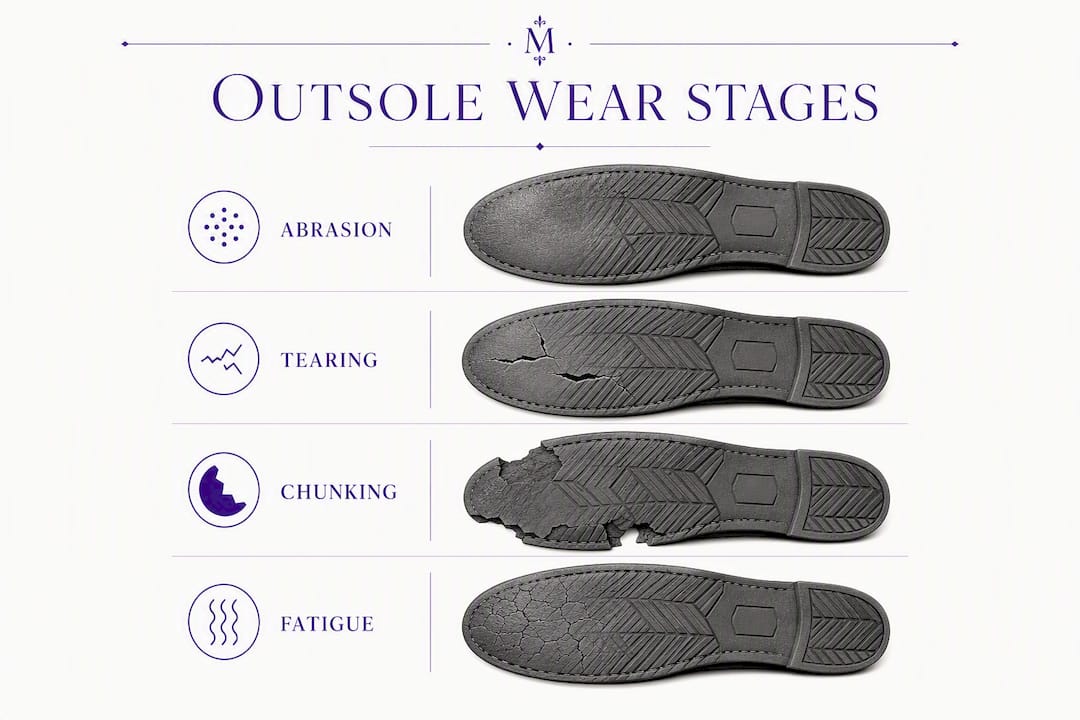
Rubber outsole durability measures a compound’s resistance to material loss under repeated ground contact. Abrasion, tearing, chunking, and fatigue are the four mechanisms that strip away tread. For athletes, that distinction matters practically: a sole that loses material slowly keeps its grip geometry intact longer, which directly affects traction and injury risk. Two industry-standard tests, ASTM D1630 and ASTM D5963, are the benchmarks labs use to screen compounds before they reach your shoe. Moreciandco applies the same principle across its gear: the material has to earn its place.
Lab numbers are useful for comparing compounds, but they are screening tools. Real-world wear depends on surface type, load, movement pattern, and maintenance. Keep that gap in mind as you read.
- Abrasion resistance: how slowly a compound loses volume under friction
- Tearing resistance: how well the rubber holds together under sharp lateral stress
- Chunking resistance: how well tread lugs resist breaking off under impact
- Fatigue resistance: how the compound handles millions of flex cycles without cracking
Table of Contents
- What actually breaks down a rubber outsole?
- How labs measure outsole durability
- Which compound elements actually drive wear resistance?
- How to read wear on your own shoes
- How to choose shoes when outsole durability matters
- Simple maintenance that extends outsole life
- Common myths about rubber outsole durability
- Key Takeaways
- Why durability is the wrong place to cut corners
- Useful sources
What actually breaks down a rubber outsole?
Four distinct wear mechanisms degrade rubber soles, and each one dominates in different sports contexts.
Abrasion is the most common. Friction against pavement, asphalt, or court surfaces grinds away the rubber surface layer with every step. Road runners see this most on the heel and forefoot strike zones. Tearing happens when lateral shear forces exceed the rubber’s tensile strength. Basketball cuts and tennis direction changes are the classic triggers. Chunking occurs when tread lugs catch on aggressive surfaces like trail rock or turf seams and break off in pieces. Trail runners and cleated athletes know this one. Fatigue is slower and subtler: the rubber cracks internally after millions of flex cycles, eventually compromising the whole structure.
Surface type changes which mechanism dominates. Asphalt accelerates abrasion. Wet courts accelerate tearing at the lug edges. Trails with sharp rock produce chunking. Synthetic turf creates a combination of abrasion and fatigue because the surface is both abrasive and repetitively compressive.
- Road running: heel and forefoot abrasion from pavement friction
- Court sports: lateral tearing at tread edges from quick direction changes
- Trail running: chunking from rock and root contact on lug tips
- Turf sports: combined abrasion and fatigue from repetitive loading
Pro Tip: Flip your shoes and look at the wear pattern. Smooth, polished zones indicate abrasion. Ragged, torn lug edges point to tearing. Missing chunks of tread are chunking. Each pattern tells you whether your compound or tread design is the limiting factor.
How labs measure outsole durability
Two ASTM methods dominate outsole compound screening in the United States.
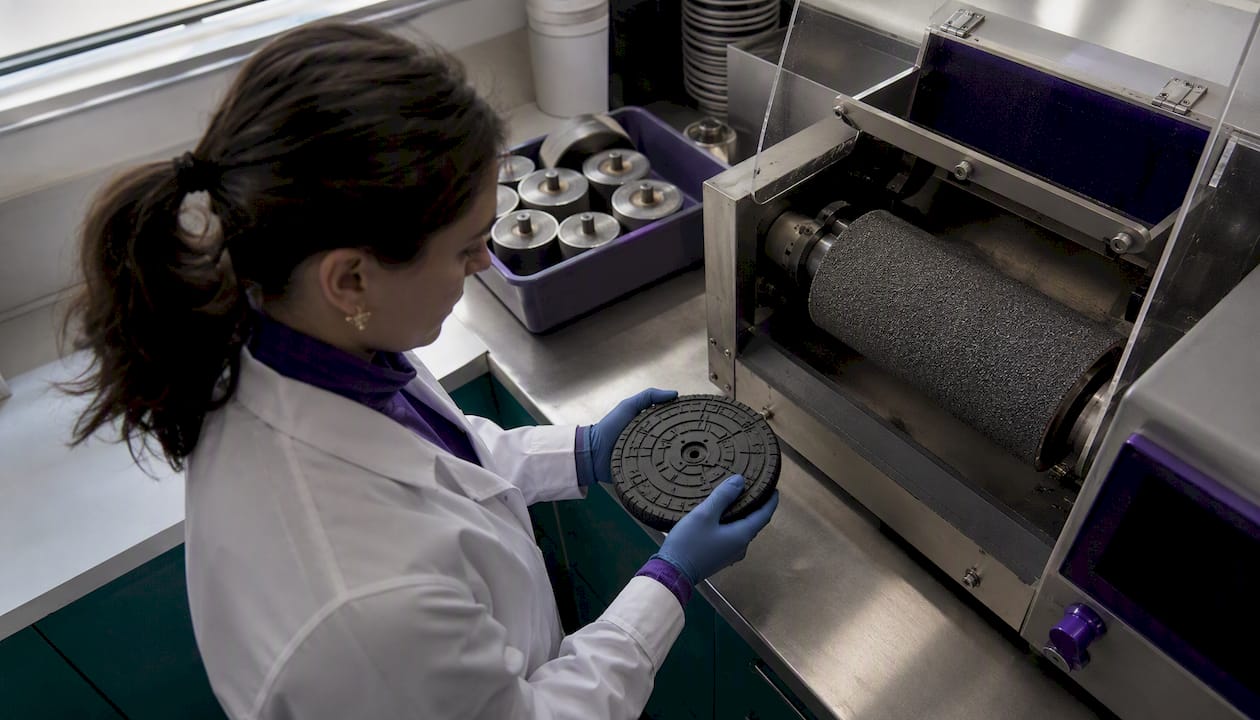
ASTM D1630 (Footwear Abrader) presses a rubber sample against a controlled abrasive surface under a set load. It is designed for vulcanized rubber compounds thicker than 2.5 mm and reports results as a relative abrasion resistance index. D1630 is the older method and is widely used for direct compound-to-compound comparisons in sole and heel applications.
ASTM D5963 (Rotary Drum Abrader) uses a rotating drum lined with an abrasive sheet. It reports results as volume loss in cubic millimeters or as an abrasion resistance index. Smaller volume loss means better abrasion resistance. D5963 is the more internationally aligned method and is often the one cited when brands publish compound performance data.
| Test | Method | Output metric | How to use it |
|---|---|---|---|
| ASTM D1630 | Footwear Abrader, controlled load | Abrasion resistance index | Compare compounds; higher index = better resistance |
| ASTM D5963 | Rotary Drum Abrader | Volume loss (mm³) or index | Lower mm³ = better; use for cross-brand screening |
| SATRA TM144 | Slip resistance on wet/dry surfaces | Coefficient of friction | Validates wet traction alongside wear data |
The critical limitation: ASTM explicitly warns that no direct correlation between accelerated lab tests and actual in-service performance should be assumed. D1630 and D5963 use different abrasive geometries and load configurations, so they will not always rank the same compounds identically. Use them as comparative screening tools, not as lifespan predictions.
- Lab tests tell you which compound resists abrasion better under controlled conditions
- They cannot account for surface variation, gait mechanics, or load intensity in real use
- A compound that scores well on D5963 may still wear faster on trail rock than a lower-scoring compound on smooth pavement
Which compound elements actually drive wear resistance?
The rubber matrix, filler type, cross-link density, and tread geometry are the four levers manufacturers pull to tune durability.
Matrix rubber sets the baseline. Natural rubber (NR) offers excellent tear resistance but wears faster on rough outdoor surfaces. Butadiene rubber (BR) adds abrasion resistance. Styrene-butadiene rubber (SBR) balances the two. Most performance outsoles use NR/BR or SBR/BR blends to get strength and abrasion resistance in one compound.
Filler type is where the most consequential trade-offs live. An ACS study found that carbon-black-filled compounds tend to show higher cross-link density and improved dry traction, while silica-filled formulations showed improved wear resistance and wet grip through increased flexibility and energy dissipation. Carbon black suits dry, high-load applications. Silica suits wet surfaces and sports where wet grip is safety-critical.
Cross-link density controls how tightly the polymer chains are bonded. Higher density resists deformation and abrasion but reduces flexibility. Lower density improves grip and energy return but wears faster. Tread thickness adds a simple buffer: more material means more wear before the structure is compromised. Asahi Kasei notes that synthetic rubber grades are selected specifically to balance grip, abrasion resistance, and durability, because no single grade maximizes all three.
When a brand says “high durability” with no test reference, ask which metric they mean. A claim backed by an ASTM D5963 volume loss figure or a SATRA TM144 wet-slip result is verifiable. A bare marketing claim is not.
How to read wear on your own shoes
Visible outsole wear is the most practical durability signal athletes have. A longitudinal study published in PMC tracked shoe traction performance over time and found that a worn region size of approximately 800 mm² was associated with notable reductions in friction and large increases in fluid force, both of which raise slip risk significantly.
- Tread depth loss: lugs flatten and the channel depth between them decreases
- Exposed midsole foam: the rubber layer has worn through entirely in a zone
- Uneven wear: one edge or zone wears faster, signaling gait asymmetry or surface bias
- Missing lugs: chunking has removed tread blocks, reducing grip geometry
- Decreased wet traction: the first functional sign that fluid drainage channels are compromised
For lifespan ranges, the same study found that several months of workplace walking corresponded to a moderate worn region size and a substantial walking distance. Running shoes see far higher loads per kilometer, so wear accumulates faster. Footwear companies commonly recommend replacement after moderate to extensive use or approximately within a year, depending on use intensity.
How to choose shoes when outsole durability matters
A four-step framework cuts through the noise when you are comparing options.
- Match compound to activity. Road running needs abrasion-resistant compounds (carbon black or NR/BR blends). Wet-surface sports need silica-filled compounds for wet grip. Trail running needs chunking-resistant tread geometry with deep lugs.
- Ask for test data. Request the ASTM D5963 volume loss figure or the SATRA TM144 slip-resistance result. If neither is available, treat durability claims as unverified.
- Check tread thickness. Thicker outsoles provide more material before wear reaches the midsole. For high-mileage athletes, this is a direct lifespan multiplier.
- Consider replaceability. Some performance shoes allow outsole resoling. For athletes who wear through soles faster than uppers, this extends total shoe life significantly.
- For high-mileage road athletes: prioritize abrasion resistance index and tread thickness
- For wet-surface sports: prioritize silica-filled compounds and SATRA TM144 wet-grip data
- For trail athletes: prioritize lug depth, chunking resistance, and NR/BR blend strength
Simple maintenance that extends outsole life
Maintenance does not reverse wear, but it meaningfully slows it.
- Rotate between two pairs. Rubber needs recovery time after compression loading. Alternating shoes extends both pairs.
- Clean grit after each session. Abrasive particles trapped in tread channels act like sandpaper on the rubber during the next use. A stiff brush and water remove them in under a minute.
- Avoid unnecessary rough surfaces. Walking on gravel or concrete in court shoes accelerates abrasion outside the intended use case.
- Store away from ozone and UV. Both degrade rubber at the molecular level. A cool, dark storage spot slows oxidation and surface cracking.
- Avoid petroleum-based solvents. They swell and weaken rubber compounds. Mild soap and water are sufficient for cleaning.
Pro Tip: After every third session, flip your shoes and spend 30 seconds checking tread depth and lug integrity. Catching early uneven wear lets you adjust your gait or surface choice before the damage accelerates.
Common myths about rubber outsole durability
Myth: Harder rubber always lasts longer. Hardness can improve abrasion resistance in some conditions, but very hard compounds lose flexibility, which increases fatigue cracking and reduces traction on uneven surfaces. The relationship is not linear.
Myth: Lab numbers equal real-world lifespan. ASTM standards explicitly state that accelerated tests should not be assumed to predict in-service performance. They are comparison tools, not odometers.
Myth: Good grip means long life. Traction and wear resistance are related but separable. A compound engineered for maximum surface adhesion, like a sticky climbing rubber, can grip exceptionally well and still wear fast on abrasive concrete. The ACS research confirms that carbon-black and silica compounds optimize for different performance axes, and neither maximizes both grip and wear simultaneously.
Key Takeaways
Rubber outsole durability is a design target, not a single material property, and the compound architecture governs how a sole performs far more than its appearance does.
| Point | Details |
|---|---|
| Durability measures material loss | Abrasion, tearing, chunking, and fatigue are the four mechanisms that remove tread. |
| ASTM tests are screening tools | D1630 and D5963 compare compounds; neither predicts exact in-service lifespan. |
| Filler type drives trade-offs | Carbon black improves dry traction; silica improves wet grip and wear resistance. |
| 800 mm² worn region signals risk | A worn region of that size correlates with 16–38% friction loss and sharply higher slip risk. |
| Rotate and clean to extend life | Alternating pairs and removing grit after sessions are the two highest-impact maintenance habits. |
Why durability is the wrong place to cut corners
Most athletes judge a shoe’s outsole by how it looks on the shelf: thickness, texture, color. None of those reliably predict how the compound will perform under load. The filler network and cross-link density, invisible to the eye, are what determine how the sole deforms and sheds material over hundreds of kilometers.
At Moreciandco, the same logic applies to every product we make. The Complesso collection is built around materials that earn their place, not materials that photograph well. When you are evaluating any piece of gear, the question worth asking is not “does it look durable?” but “what is it actually made of, and what does the evidence say about how it performs?”
For outsoles specifically, that means asking for compound data, not just brand claims. It means understanding that a silica-filled sole and a carbon-black sole are not interchangeable, even if they look identical. And it means replacing shoes when the worn region tells you to, not when the upper finally gives out.
The brands worth trusting are the ones that can answer the compound question. If they cannot, the durability claim is decoration.
Useful sources
The following primary references support the technical claims in this guide and are worth consulting directly for compound science and test method details.
- ASTM D1630: Standard Test Method for Rubber Property — Abrasion Resistance (Footwear Abrader). The primary U.S. standard for comparing vulcanized rubber compounds in sole and heel applications.
- ASTM D5963: Standard Test Method for Rubber Property — Abrasion Resistance (Rotary Drum Abrader). Reports volume loss in mm³; the more internationally aligned method and the one most commonly cited in compound data sheets.
- ACS Applied Materials & Interfaces: “Tailoring Rubber-based Shoe Outsole Compounds: Impact of Blend Composition and Filler Type on Slip Resistance and Tribological Performance.” The primary research source for carbon black vs. silica trade-off data cited in this guide.
- Asahi Kasei Outsole Applications: Industry-level overview of synthetic rubber grade selection for outsole performance targets.
- Northstar Footwear Industry Primer: Practical formulation notes on NR/BR blends and filler combinations for abrasion resistance.
- PMC Longitudinal Traction Study: Quantifies traction loss against wear metrics including worn region size, distance walked, and months of use.
Use ASTM standards as comparative frameworks when evaluating supplier claims. For material-grade questions specific to a compound or application, contact the manufacturer or a rubber compounding specialist directly.