


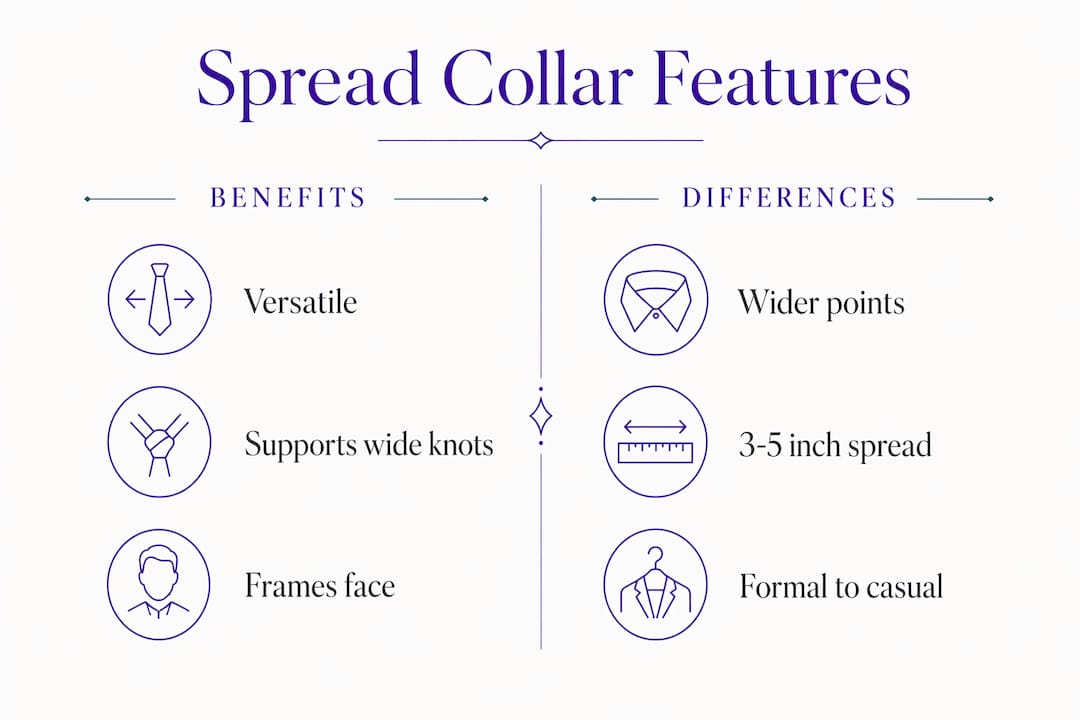
A spread collar shirt is defined by collar points that angle outward at a wider distance than a traditional point collar, creating an open frame around the neck. That wider gap is not decorative. It exists to accommodate larger tie knots like the Full Windsor and Half-Windsor, and it gives the shirt a distinctly modern silhouette. Brands like Brooks Brothers, The Tie Bar, and Hugh & Crye have built entire shirt lines around this collar shape because it works across business, formal, and smart-casual settings without modification. Understanding what is spread collar shirt design means understanding one of the most versatile collar choices in a well-built wardrobe.
What is a spread collar shirt, and how is it defined?
A spread collar shirt features collar points that sit between 3 and 5 inches apart, angled outward to create visible space at the neckline. The industry term for the broader category is “spread collar,” though you will also hear “English spread” for a moderate version and “cutaway” for the most extreme angle. The spread collar sits between the narrow point collar and the wide cutaway on the spectrum of collar shapes.
Fashion experts recommend spread collars for medium to large tie knots, specifically the Windsor and Half-Windsor, to fill the wider gap between the collar points. That recommendation exists because a narrow knot in a spread collar looks lost. The collar frame demands a knot with enough volume to anchor it visually.

Spread collars have been a staple in British and European tailoring since the 1920s, according to Brooks Brothers. Their longevity is not accidental. The shape flatters a wide range of face types and body proportions, which makes it a reliable default for men and women who want a shirt that reads polished without being rigid.
How does a spread collar differ from other shirt collars?
The spread collar occupies a specific position among the major collar types. A point collar has collar points that angle downward and sit close together, typically 2 to 3 inches apart. A cutaway collar pushes the points nearly horizontal, sometimes 6 or more inches apart. The spread collar sits in the middle, offering a moderate wide space ideal for varying knot sizes.
| Collar Type | Point Spacing | Best Tie Knot | Best Occasion |
|---|---|---|---|
| Point collar | Narrow, 2–3 inches | Four-in-hand, Pratt | Business casual, everyday |
| Spread collar | Moderate, 3–5 inches | Half-Windsor, Windsor | Business, formal, smart-casual |
| Cutaway collar | Wide, 5+ inches | Full Windsor, Nicky | Formal, fashion-forward events |
The practical difference shows up most clearly when you add a tie. A point collar pairs best with a slim knot because the narrow gap cannot absorb a thick Windsor without bunching. A spread collar handles both slim and wide knots, which is why it reads as more versatile. The cutaway collar is the most demanding. It requires a large, confident knot and a formal setting to avoid looking oversized.
Face shape also plays a role. Spread collars add symmetry for narrow faces by widening the visual frame at the neck. Point collars do the opposite, elongating the face. Knowing this distinction helps you choose a collar that works with your features rather than against them.
What are the benefits of spread collar shirts?
The primary benefit of a spread collar shirt is its range. It moves from a formal boardroom setting to a smart-casual Friday without requiring a different shirt. That flexibility comes from the collar’s neutral angle, which reads as polished with a tie and clean without one.
Spread collars accommodate wider tie fabrics like wool and cashmere, not just silk. Heavier knit ties, which have become a strong trend in 2026 menswear, sit naturally in the wider collar frame. A point collar would compress those fabrics and distort the knot shape.
Key benefits of the spread collar shirt style include:
- Tie versatility: Works with Full Windsor, Half-Windsor, and Pratt knots without crowding the collar frame.
- Face shape balance: The wider angle adds visual width, flattering narrower or longer face shapes.
- Occasion range: Appropriate for black-tie adjacent events, business meetings, and open-collar casual looks.
- Fabric compatibility: Pairs with silk, wool, and cashmere ties without distorting the knot.
- Modern aesthetic: Reads as contemporary without being trendy, making it a long-term wardrobe investment.
Pro Tip: If you wear a spread collar without a tie, insert collar stays to keep the points flat and structured. Without them, the collar points curl upward and the shirt loses its shape entirely.
How to wear a spread collar shirt for different occasions
Fit is the first variable to address. The shoulder seam must align with the end of your shoulder bone. A seam that drops onto the upper arm signals a shirt that is too large, and no amount of collar styling corrects that impression. Sleeve length should allow a quarter inch of cuff to show below a jacket sleeve.
Business and formal settings
- Choose the right knot. A Full Windsor or Half-Windsor fills the collar gap and creates a symmetrical triangle. A four-in-hand knot is too slim for most spread collars and will look underdressed.
- Tuck the collar points under jacket lapels. Collar points hidden beneath lapels create a cleaner, more formal silhouette. Visible collar points above the lapel read as a fit issue.
- Match tie width to lapel width. A tie that is narrower than the lapel creates visual imbalance. Aim for the tie tip to align with the trouser waistband.
- Select structured fabrics. Poplin and broadcloth hold their shape under a jacket. Linen and chambray are better reserved for casual settings where the collar will be worn open.
Pro Tip: For a business presentation or formal event, pair a white or light blue spread collar shirt with a navy suit and a silk Windsor knot tie. That combination works in virtually every professional context without looking like you tried too hard.
Smart-casual and open-collar looks
Wearing a spread collar open requires a different approach. The collar points need support because there is no tie to anchor them. Collar stays, either metal or magnetic, keep the points crisp and maintain a structured look. Without them, the collar flattens and the shirt reads as sloppy rather than relaxed.
Layer the shirt under a crewneck sweater or a merino V-neck for a smart-casual look that works in most office environments. The collar points frame the neckline above the sweater and add visual interest without requiring a tie. This is one of the most underused styling moves in menswear.
What to pair with a spread collar shirt: ties, jackets, and casual options
The spread collar shirt style rewards thoughtful pairing. The collar’s wider frame sets expectations for everything else in the outfit.
Ties and knots:
- Silk ties in a Full Windsor or Half-Windsor are the standard pairing for formal occasions.
- Wool and cashmere knit ties work well for business casual settings. Their texture fills the collar gap naturally.
- Avoid slim ties under 2.5 inches wide. They look proportionally wrong against the wider collar frame.
Jackets and lapels:
- A notch lapel suit jacket is the most common pairing and works in nearly every setting.
- Peak lapels on a double-breasted jacket create a strong, formal look that the spread collar supports well.
- Avoid very narrow lapels. A lapel under 2 inches wide will compete with the collar rather than complement it.
Casual layering:
- A merino crewneck or V-neck sweater over an open spread collar shirt is a clean, modern look.
- Unstructured blazers in linen or cotton work for warm-weather smart-casual outfits.
- Chinos or tailored trousers complete the look better than jeans in most settings where a spread collar shirt is appropriate.
Maintaining collar crispness matters as much as the initial pairing. Press the collar with a steam iron before wearing. Use starch on poplin or broadcloth shirts for maximum structure. Check out the full guide on collar stays to understand which type works best for your collar weight and fabric.
For a broader look at how spread collar shirts fit into a complete wardrobe, the dress shirts guide for 2026 covers every major collar type and when to wear each one.
Key Takeaways
The spread collar shirt is the most versatile dress shirt collar available, working across formal, business, and smart-casual settings when paired and fitted correctly.
| Point | Details |
|---|---|
| Collar definition | Spread collars feature points angled 3–5 inches apart, wider than point collars and narrower than cutaway collars. |
| Tie knot match | Use a Full Windsor or Half-Windsor to fill the wider collar gap and maintain visual proportion. |
| Fit standard | Shoulder seams must align with the shoulder bone end, and collar points should tuck under jacket lapels. |
| Collar stays | Insert collar stays when wearing open-collar to prevent points from curling and losing structure. |
| Face shape benefit | The wider collar angle adds visual width, making it a strong choice for narrower or longer face shapes. |
Why the spread collar is the one collar worth mastering
The spread collar gets dismissed as a “safe” choice, but that reading misses the point. Safe implies boring. The spread collar is actually the most technically demanding collar to wear well, because it exposes every fit and proportion mistake. A collar point visible above a jacket lapel, a narrow tie lost in a wide frame, a shirt with shoulder seams that hang off the arm. All of those errors are invisible on a point collar and glaring on a spread collar.
What I have found after years of watching people dress is that the spread collar rewards the person who pays attention to fit first. Get the shoulder seam right, choose the correct knot size, and use collar stays when going open-collar. Do those three things and the spread collar makes almost any outfit look intentional.
The face shape angle is also underappreciated. Men and women with narrow faces often default to point collars because they feel “classic.” But a spread collar adds horizontal width at the neck, which creates balance. The point collar elongates. The spread collar centers. For most face shapes, centering is the better outcome.
The one pitfall I see consistently is people wearing spread collars with slim ties because they own slim ties and do not want to buy new ones. The result looks like the tie is drowning in the collar. A Half-Windsor in a medium-width tie costs nothing extra if you already own the tie. It just requires tying a different knot. That single change transforms the outfit.
— Giuseppe
Quality spread collar shirts worth wearing
Moreciandco was built on a straightforward idea: you should get what you pay for. That applies directly to spread collar shirts, where fabric quality and collar construction determine whether the shirt holds its shape after ten washes or loses it after two.
The Moreciandco store carries spread collar shirts cut for real proportions, with collar construction that maintains its angle without constant ironing. The collar stays work with the fabric weight rather than against it. If you are building a wardrobe around spread collar shirts, the Complesso Collection offers pieces that integrate directly with the collar styles covered here. Quality at this level is not a luxury. It is the baseline for a shirt that actually performs.
FAQ
What is a spread collar shirt?
A spread collar shirt is a dress shirt with collar points angled outward at a wider distance than a point collar, typically 3–5 inches apart. The wider gap accommodates larger tie knots like the Full Windsor and creates a modern, open neckline.
What tie knot works best with a spread collar?
The Full Windsor and Half-Windsor are the best tie knots for a spread collar shirt. Both knots produce a wide, symmetrical triangle that fills the collar gap without looking undersized.
Can you wear a spread collar shirt without a tie?
Yes. Wear collar stays to keep the collar points flat and structured when going open-collar. Without collar stays, the points curl upward and the shirt loses its polished appearance.
How does a spread collar differ from a point collar?
A point collar has narrow, downward-angled points set 2–3 inches apart, suited for slim tie knots. A spread collar has wider, outward-angled points set 3–5 inches apart, suited for larger knots and a more contemporary look.
What fabrics work best for a spread collar shirt?
Poplin and broadcloth are the best fabrics for spread collar shirts because they hold their shape and press cleanly. Wool and cashmere ties pair well with the wider collar frame for business and formal occasions.